NGSS standards
High school physics skills are aligned to NGSS physical science standards, so tutoring matches what your child is graded on at school.

High school & college
Pioneered by Stanford AI researchers and learning scientists, Aristotle is the world's first voice-based AI physics tutor. From high school physics through college astrophysics, Aristotle has improved thousands of grades over 22% within a week.
Trusted by families at















Fits your child's physics class
High school physics skills are aligned to NGSS physical science standards, so tutoring matches what your child is graded on at school.
Share the syllabus or textbook and sessions follow your child's actual class, whether that's public, private, or homeschool.
Working toward a final exam, a placement test, or getting a grade up? Aristotle builds the path backwards from your goal.
Features
Talk things through, work side by side, and come back next time to a tutor who remembers where you left off.
Ask questions out loud, hear explanations in Aristotle’s voice, and interrupt whenever you need to.
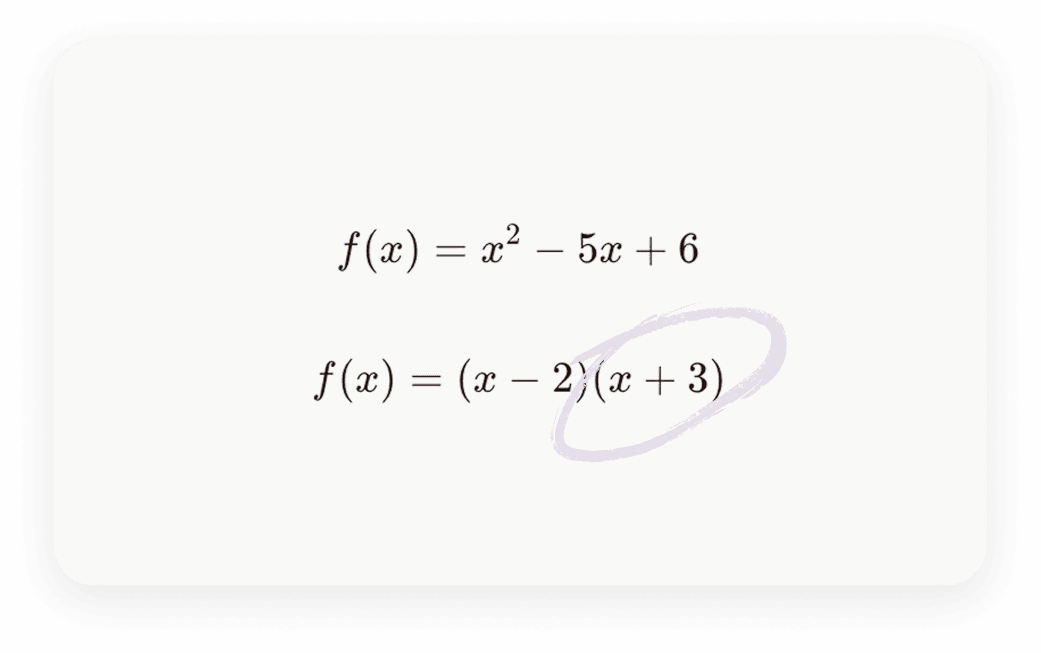
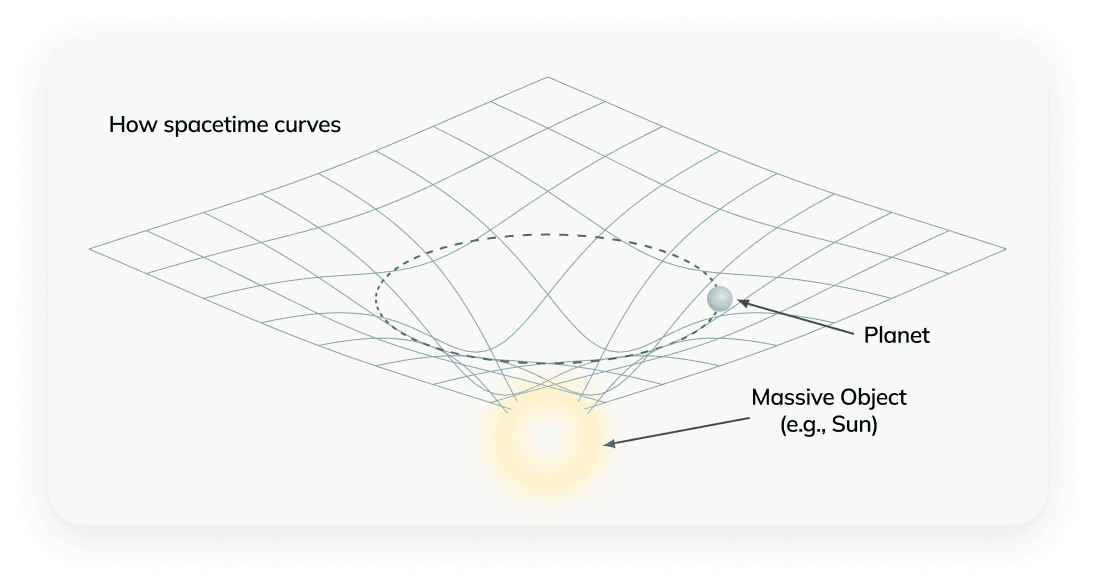
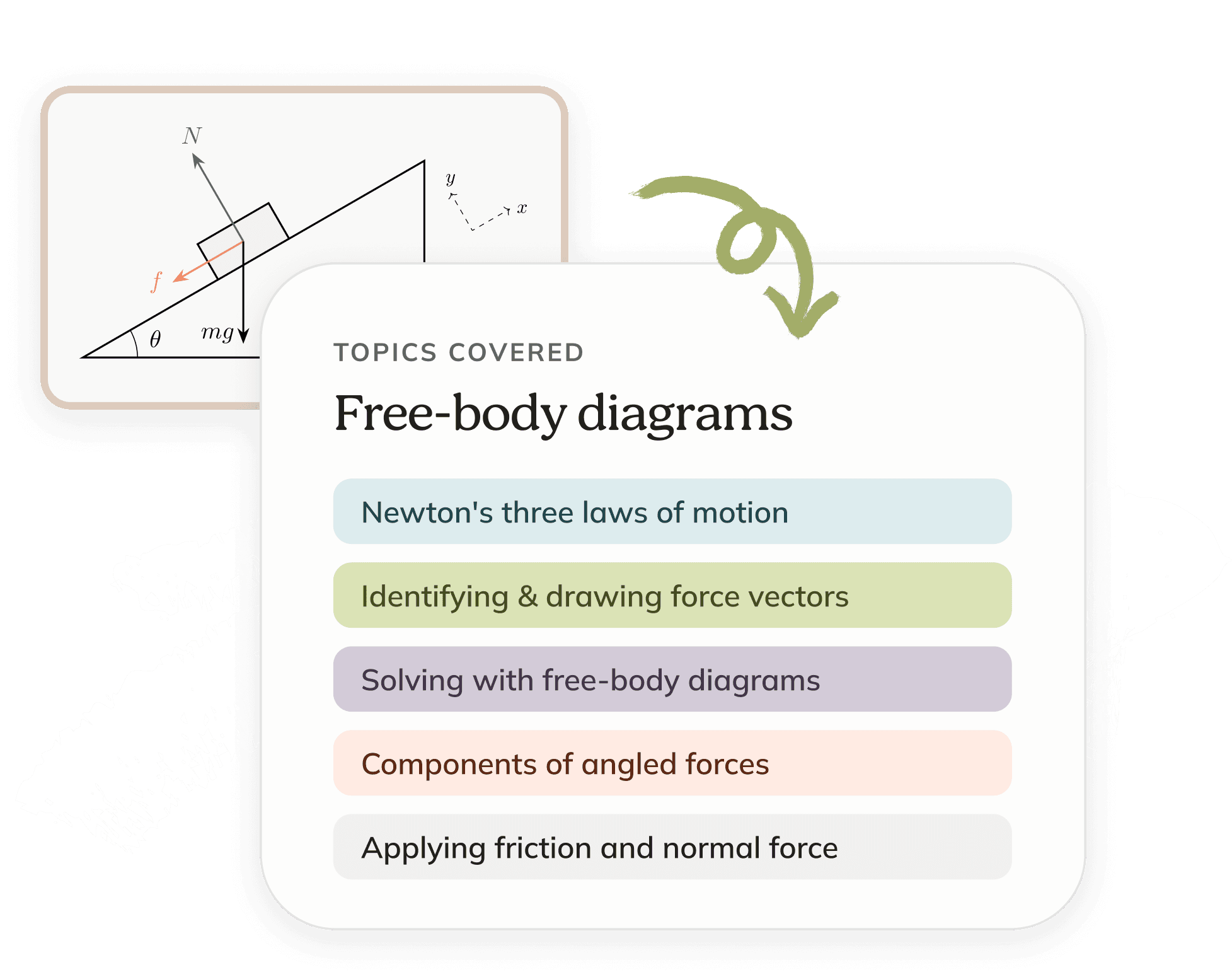
Aristotle draws steps, diagrams, and images to help you learn visually.
Get practice problems tailored to the exact topics you’re struggling with.
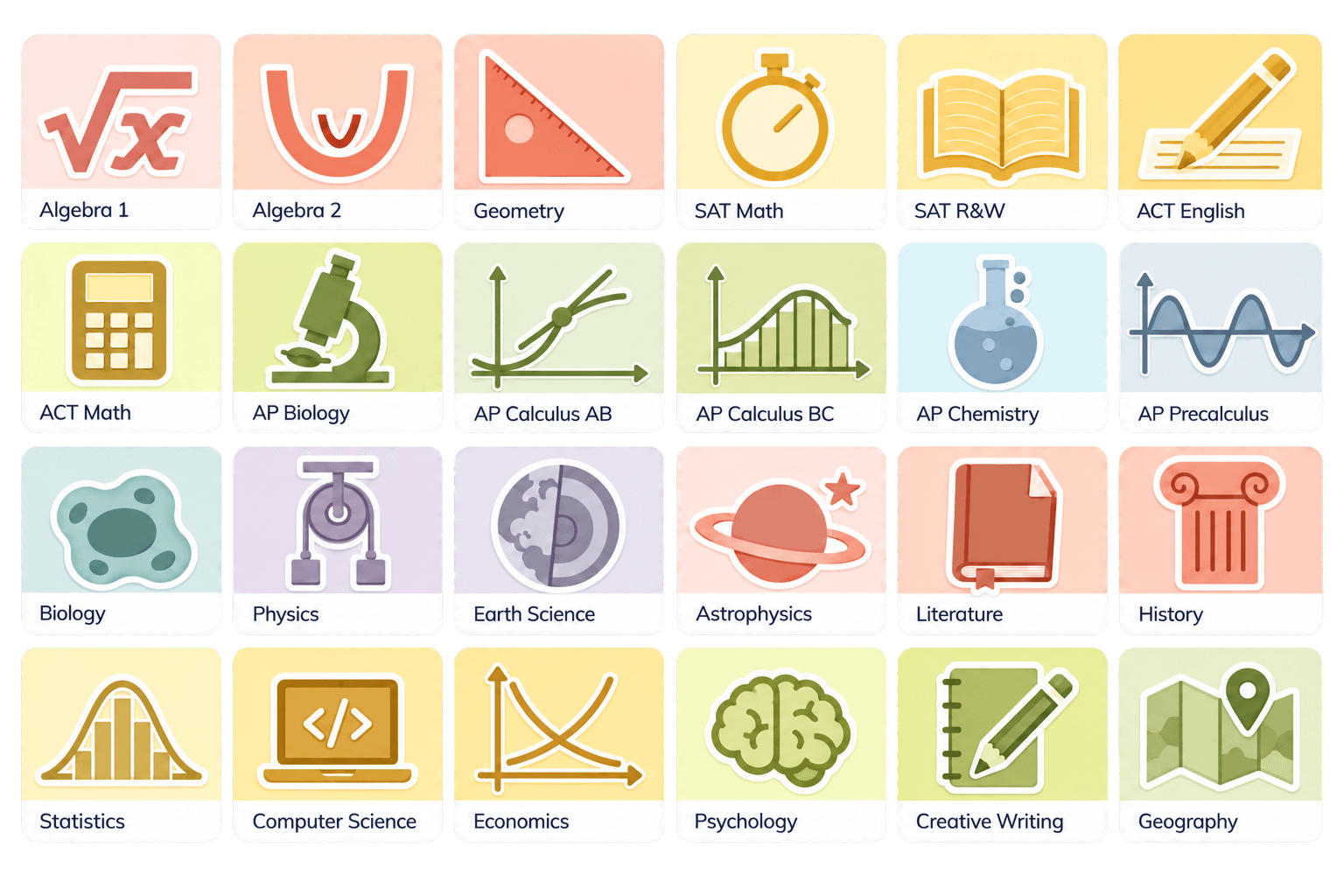
From middle-school math to AP exams to SAT/ACT prep. We also build custom plans matched to state standards and specific courses.
Revisit session summaries, session whiteboards, and uploads in one place.
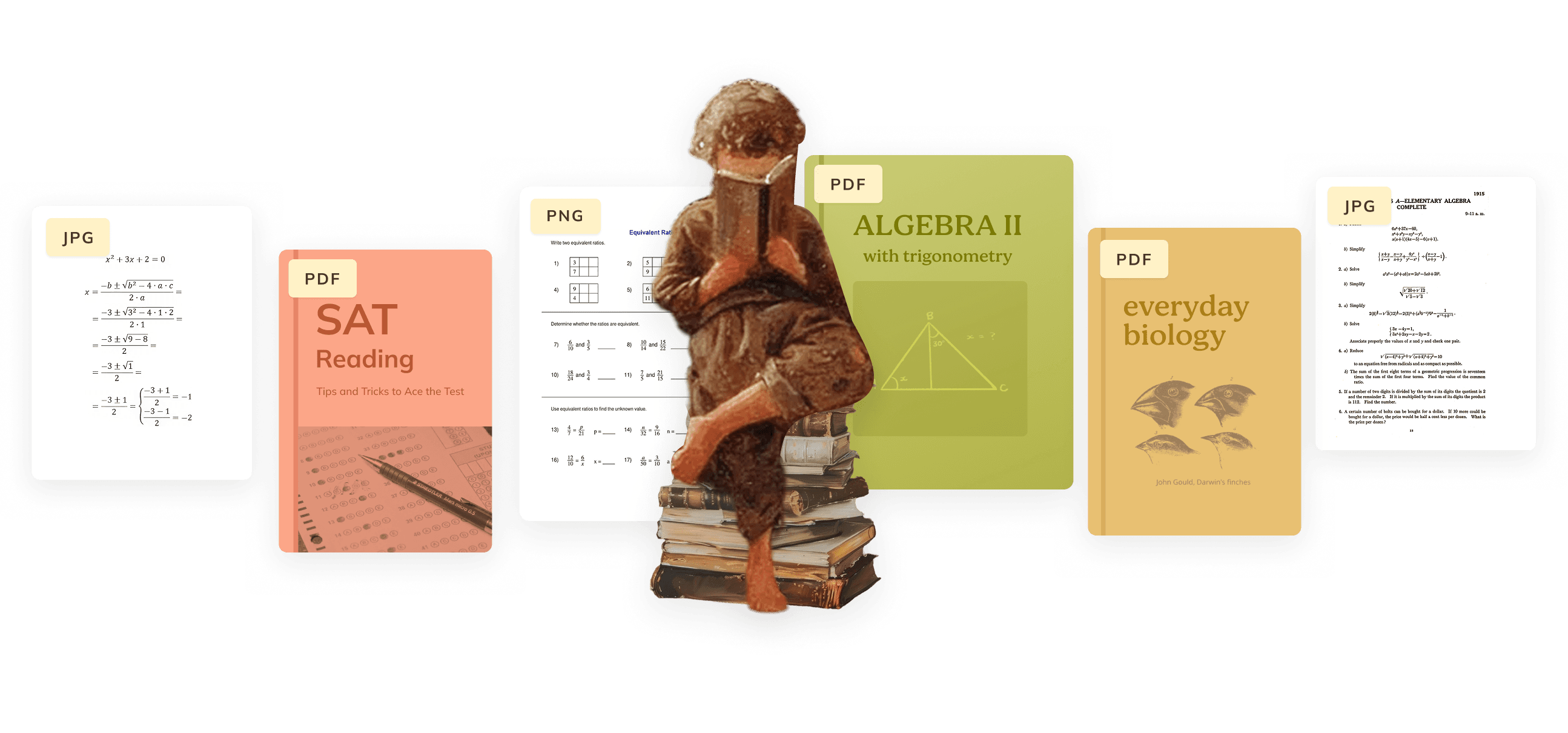
Aristotle can read and navigate any PDFs and images with the learner. That includes textbooks with hundreds of pages!
We break all subjects down into granular skills, then track mistakes and mastery on each one. Parents can see the whole picture at a glance.
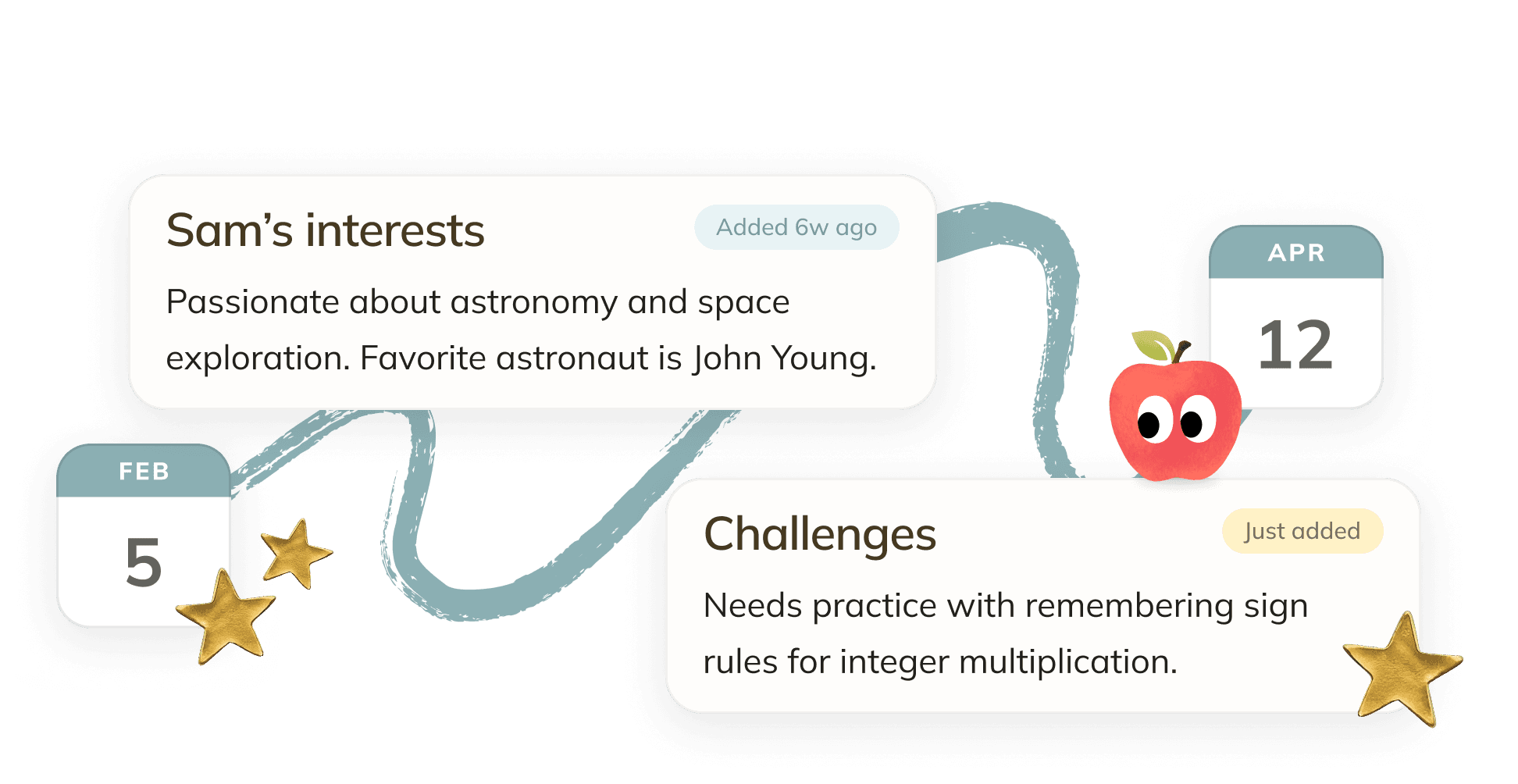
Aristotle remembers every session: what you’ve covered, where you got stuck, how you like things explained. It picks up right where you left off.
The curriculum
Aristotle is designed to always know what to teach at exactly the right time.
Sample curriculum
+ 6 more science subjects available
* Click a topic to see the skills inside
Foundations & Measurement
Kinematics
Forces & Newton's Laws
Work & Energy
Momentum & Collisions
Rotational Motion
Gravitation
Oscillations
Waves & Sound
Fluids
Thermodynamics
Electrostatics
Electric Circuits
Magnetism & Electromagnetic Induction
Optics
Modern Physics
Physics tutoring curriculum187 skills across 16 units
Foundations & Measurement
Lean diagnostic on-ramp for the measurement, unit, and vector skills every later mechanics unit assumes: SI units, dimensional analysis, significant figures, vector arithmetic, and estimation. Topics: Units, Dimensions & Precision, Vectors & Scalars, Estimation & Measurement Reasoning.
Kinematics
Describing motion without yet asking what causes it: displacement, velocity, acceleration, free fall, projectiles, and relative motion in 1D and 2D/3D, plus reading and translating motion graphs. Topics: Motion in One Dimension, Motion Graphs, Free Fall, Projectile & 2D Motion.
Forces & Newton's Laws
Why motion changes: Newton's three laws, free-body diagrams, and the common contact and field forces (gravity, normal, tension, friction), including the dynamics of uniform circular motion. Topics: Newton's Laws & Free-Body Diagrams, Common Forces, Applying Newton's Laws, Circular Motion Dynamics.
Work & Energy
Energy as a conserved bookkeeping quantity: work, kinetic and potential energy, power, conservation of mechanical energy, and energy loss to non-conservative forces. Topics: Work & Power, Kinetic & Potential Energy, Conservation of Energy.
Momentum & Collisions
Momentum as the conserved quantity of interactions: the impulse-momentum theorem, conservation of linear momentum, collision analysis, and center of mass. Topics: Impulse & Momentum, Conservation of Momentum & Collisions, Center of Mass.
Rotational Motion
The rotational analogues of linear mechanics: rotational kinematics, torque and moment of inertia, rotational dynamics, angular momentum and its conservation, and rolling. Topics: Rotational Kinematics, Torque & Moment of Inertia, Rotational Dynamics & Energy, Angular Momentum.
Gravitation
Gravity as a universal field force: Newton's law of universal gravitation, the gravitational field and potential energy, and orbital motion governed by Kepler's laws. Topics: Universal Gravitation, Gravitational Potential Energy, Orbits & Kepler's Laws.
Oscillations
Periodic motion about an equilibrium: simple harmonic motion, springs and pendulums, energy exchange in SHM, and an introduction to damping and resonance. Topics: Simple Harmonic Motion, Springs & Pendulums, Energy, Damping & Resonance in SHM.
Waves & Sound
Mechanical waves as the transport of energy and a disturbance without net transport of matter: wave anatomy and the wave equation, superposition and interference, standing waves and resonance, and the sound applications (intensity, beats, Doppler) those ideas explain. Topics: Wave Properties & the Wave Equation, Wave Behavior at Boundaries, Superposition, Interference & Standing Waves, Sound, Intensity & the Doppler Effect.
Fluids
Pressure and buoyancy in fluids at rest, and the conservation laws governing fluids in motion. Topics: Density & Pressure, Buoyancy & Archimedes' Principle, Fluid Dynamics.
Thermodynamics
Temperature, heat, and energy at the level of many particles: the distinction between temperature and heat, thermal expansion, calorimetry and phase change, the kinetic-molecular model of gases and the gas laws, and the first and second laws of thermodynamics. Topics: Temperature, Heat & Thermal Expansion, Specific Heat & Phase Change, Kinetic Theory & Gas Laws, Laws of Thermodynamics.
Electrostatics
Electric charge at rest and the field and potential it creates: charge and its conservation, Coulomb's law, the electric field, electric potential and potential energy, conductor/insulator behavior, and an introduction to capacitance. Topics: Charge & Coulomb's Law, The Electric Field, Electric Potential & Potential Energy, Conductors, Insulators & Capacitance.
Electric Circuits
Charge in steady motion through circuits: current and resistance, Ohm's law, series and parallel networks, electrical power and energy, Kirchhoff's rules, and capacitors as circuit components. Topics: Current, Resistance & Ohm's Law, Series & Parallel Circuits, Electrical Power & Energy, Kirchhoff's Rules & Capacitors in Circuits.
Magnetism & Electromagnetic Induction
Magnetic fields, the forces they exert, the currents that create them, and the changing flux that induces EMF: magnetic force on charges and currents, sources of the magnetic field, Faraday's and Lenz's laws, and an introduction to electromagnetic waves. Topics: Magnetic Fields & Forces, Sources of the Magnetic Field, Electromagnetic Induction, Introduction to Electromagnetic Waves.
Optics
The behavior of light as both rays and waves: the EM spectrum context, geometric optics with mirrors and lenses, and wave optics through interference and diffraction. Topics: Light & the EM Spectrum, Reflection & Refraction, Mirrors & Lenses, Wave Optics.
Modern Physics
Physics beyond the classical picture: special relativity, the quantum nature of light, atomic models, and nuclear physics and radioactivity. Topics: Special Relativity (Intro), Quantum Nature of Light, Atomic Models & Spectra, Nuclear Physics & Radioactivity.
Astrophysics tutoring curriculum311 skills across 14 units
Astrophysical Tools & Measurement
A standalone, tools-first opener that equips the student with the measurement toolkit astrophysics runs on: astronomical units and scale, orders-of-magnitude estimation, dimensional analysis, angular measure and the small-angle approximation, significant figures, uncertainty propagation, and the curve-fitting/linearization techniques used to extract physics from data. Topics: Units, Scale & Dimensional Reasoning, Angular Measure, Significant Figures & Uncertainty, Graphical Analysis & Curve Fitting.
The Celestial Sphere, Coordinates & Time
The headline foundation unit the prior survey-shaped map collapsed into a single sub-bullet: spherical trigonometry on the celestial sphere; the four working coordinate systems (altitude-azimuth, equatorial, ecliptic, galactic) and transformations between them; solar, sidereal, and Julian time and the equation of time; precession, nutation, proper motion, and parallax; and the eclipse/season/rise-set phenomena these tools predict. Topics: Spherical Trigonometry on the Sky, The Celestial Sphere & Its Motions, Celestial Coordinate Systems & Transforms, Time Systems, Precession, Proper Motion & Parallax, Sky Phenomena: Seasons, Rise/Set & Eclipses.
Gravity, Orbits & Celestial Mechanics
The Newtonian core of astrophysics: the universal law of gravitation and its surface and potential-energy consequences; the geometry of the ellipse and Kepler's three laws (circular and elliptical); orbital energy, angular momentum, escape speed, and the vis-viva relation that classify and quantify any two-body orbit; the centre-of-mass / reduced-mass formulation that sets up mass determination; and the gravity-gradient phenomena (tides, the Roche limit, and Lagrange points). Topics: Newtonian Gravity & Gravitational Energy, Kepler's Laws & the Geometry of the Ellipse, Orbital Energy, Angular Momentum & Vis-Viva, The Two-Body Problem, Barycentre & Reduced Mass, Tides, the Roche Limit & Lagrange Points.
Radiation, Light & Magnitudes
The measurement spine of stellar astrophysics: the wave-and-photon nature of light and the electromagnetic spectrum; the continuous (blackbody) spectrum with Planck's law qualitatively, Wien's displacement law, and the Stefan-Boltzmann law; the flux/luminosity/intensity distinction and the inverse-square law of brightness; the apparent and absolute magnitude scales with the distance modulus; and color index (B-V), its link to temperature, and bolometric magnitude and correction. Topics: Light & the Electromagnetic Spectrum, Blackbody Radiation, Flux, Luminosity & the Inverse-Square Law, The Magnitude Scale, Color Index, Temperature & Bolometric Magnitude.
Light–Matter Interaction & Spectra
How atoms imprint information on starlight: the Bohr model and quantized energy levels that fix the hydrogen (Rydberg) spectrum, the photon emission and absorption that make spectral lines, Kirchhoff's three spectrum types, the Doppler shift (classical and relativistic) that turns line positions into radial velocities, the three line-broadening mechanisms that set line widths, and the Boltzmann and Saha equations that set how many atoms sit in each excitation and ionization state. Topics: Atomic Structure & the Bohr Model, Kirchhoff's Laws & Spectrum Types, The Doppler Shift & Radial Velocity, Spectral Line Formation, Spectral Line Broadening, Excitation & Ionization Populations.
Telescopes, Detectors & Multi-wavelength Astronomy
The observational-techniques unit: geometric optics of telescopes (focal length, focal ratio, plate scale, magnification), the two performance budgets every observation lives within (light-gathering power from aperture area, angular resolution from the diffraction limit and atmospheric seeing), reflector-vs-refractor design and its aberrations, the detectors that record light (the eye, CCDs, quantum efficiency) and the photometry/astrometry techniques built on them, and the atmospheric windows that force astronomy across the whole spectrum (radio to gamma) and onto interferometers and space platforms. Topics: Geometric Optics of Telescopes, Light-Gathering Power & Limiting Magnitude, Angular Resolution, Seeing & Interferometry, Telescope Designs & Aberrations, Detectors & Observational Techniques, Atmospheric Windows & Multi-wavelength Astronomy.
Binary Stars & Stellar Parameters
Binaries are THE direct mass-measurement tool in astrophysics: this unit classifies the binary systems astronomers actually observe (visual, astrometric, spectrum, spectroscopic single/double-lined, eclipsing) by what each can yield, then turns their observables into stellar parameters, mass ratios from the centre of mass, total masses from Kepler's third law, the spectroscopic mass function and the inclination problem, eclipse light curves into relative radii and temperature ratios, and the empirical mass–luminosity relation. Topics: Classifying Binary Systems, Stellar Masses from Visual Binaries, Spectroscopic Binaries & the Mass Function, Eclipsing Binaries: Radii & Temperature Ratios, The Mass–Luminosity Relation.
Stellar Classification & the HR Diagram
The organizing map of stellar astrophysics: the OBAFGKM Harvard spectral sequence read as a temperature sequence (applying U5's Saha/Boltzmann physics to explain which lines dominate at which temperature and how to assign a spectral type), the MK luminosity classes I-V tied to atmospheric pressure and line width, and the Hertzsprung-Russell / color-magnitude diagram (its axes, its main-sequence / giant / supergiant / white-dwarf regions, reading radius from position, and inferring distance by spectroscopic parallax). Topics: The OBAFGKM Spectral Sequence, MK Luminosity Classes, The Hertzsprung-Russell Diagram, The Color-Magnitude Diagram, Spectroscopic Parallax.
Stellar Atmospheres & Interiors
The heaviest unit, kept as one but split into two cleanly separable halves. Topics: The Radiation Field: Intensity, Flux & Radiation Pressure, Opacity, Mean Free Path & the Optical-Depth Scale, Radiative Transfer, the Gray Atmosphere & Line Formation, Hydrostatic Equilibrium & the Equation of State, Nuclear Energy Generation in Stars, Energy Transport: Radiative Diffusion & Convection, Stellar Structure Equations, the Virial Theorem & Timescales, The Sun as the Calibrating Standard Model.
Star Formation, Evolution & the ISM
The full life cycle of a star and the medium it forms from and returns to: the phases of the interstellar medium (dust, extinction and reddening, neutral and molecular hydrogen, the 21-cm line, H II regions); the Jeans criterion and gravitational collapse that turn a molecular cloud into a protostar; pre-main-sequence and main-sequence evolution; the post-main-sequence ascent (red-giant branch, helium flash, horizontal branch, AGB, planetary-nebula ejection context) for low- and high-mass stars; star clusters and the main-sequence turnoff read as an evolutionary clock via isochrones; the nucleosynthetic enrichment of the ISM including the s- and r-process; and stellar pulsation (the instability strip, Cepheids and RR Lyrae, and the period-luminosity relation that anchors the cosmic distance ladder). Topics: The Interstellar Medium, Star Formation & Collapse, Main-Sequence Evolution, Post-Main-Sequence Evolution, Star Clusters as Evolutionary Clocks, Nucleosynthesis & Chemical Enrichment, Stellar Pulsation & Variable Stars.
Stellar Death & Compact Objects
How massive and accreting stars die and what they leave behind: core-collapse and Type Ia supernovae and their energetics and light curves; the three degenerate end states (white dwarfs supported by electron degeneracy with the mass-radius relation and Chandrasekhar limit, neutron stars and pulsars supported by neutron degeneracy, and black holes); a formula-level general-relativity bridge (the relativistic time-dilation/spacetime-interval tool-pieces, the Schwarzschild radius, gravitational redshift, and the event horizon, with no tensor calculus); and the accretion physics of interacting binaries (Roche lobes and mass transfer, accretion-disk power and temperature, the Eddington luminosity, X-ray binaries and novae). Topics: Supernovae & Their Aftermath, White Dwarfs & Electron Degeneracy, Neutron Stars & Pulsars, Relativity, Schwarzschild Geometry & Black Holes, Accretion & Interacting Binaries.
The Milky Way & Galaxies
Galactic-scale astrophysics from our own Galaxy outward: the Milky Way's disk/bulge/halo structure, its rotation curve and the galactic dark-matter case, stellar populations, and the Sgr A* central black hole; the morphological classification and structural scaling relations of galaxies; the extragalactic distance ladder beyond Cepheids (Tully-Fisher, the fundamental plane, Type Ia supernovae); galaxy formation, mergers and starbursts; clusters, the cluster virial mass and dark-matter problem, gravitational lensing, and large-scale structure; and active galaxies powered by accreting supermassive black holes. Topics: The Milky Way Galaxy, Galaxy Morphology & Structure, The Extragalactic Distance Ladder, Galaxy Formation & Evolution, Galaxy Clusters & Large-Scale Structure, Active Galaxies & AGN.
Cosmology & the Early Universe
The physical history of the whole universe, told from the observations that anchor it. Topics: Cosmic Expansion & Hubble's Law, Scale Factor, Critical Density & the Fate of the Universe, The Cosmic Microwave Background, Big Bang Nucleosynthesis & the Hot Big Bang, Dark Energy & Accelerating Expansion, Inflation & the Horizon and Flatness Problems.
The Solar System & Exoplanets
Planetary science applied to the Solar System and beyond: the orbital phenomena specific to Solar System bodies (sidereal vs synodic periods, retrograde motion, spin-orbit/tidal locking), the physical processes that shape planets (differentiation, equilibrium temperature, atmospheres, magnetospheres), the terrestrial-versus-giant planet contrast, the minor bodies (asteroids, comets, Kuiper Belt and trans-Neptunian objects, meteoroids), the nebular hypothesis of planet formation (condensation, the frost line, planetesimal accretion), and the exoplanet detection methods (radial velocity, transit, direct imaging, microlensing) and what each measures. Topics: Solar System Orbital Phenomena, The Terrestrial Planets, The Giant Planets, Minor Bodies of the Solar System, Formation of Planetary Systems, Exoplanet Detection.
My son told me yesterday that we should cancel his human tutor, because Aristotle is doing a better job. The human tutor was $250/hour.

A few things you might wonder before getting started.
Aristotle tutors a complete high school physics course and a college-level astrophysics course for students who want to go further. Together they map nearly 500 individually tracked skills, from kinematics, forces, and energy through circuits, optics, and modern physics, so the tutor always knows what your child has mastered and what comes next.
Check out our most recent blog posts.
This could be you
For homework, supporting your child, or anything you’ve always wanted to know more about, Aristotle makes it easy for anyone to learn out loud.