State standards
Every math skill is aligned to Common Core standards, so tutoring matches what your child is graded on at school.

Grades 6–12
Aristotle listens as your child works through math out loud, then teaches from the point where they got stuck. Pre-algebra through AP Calculus, whenever they need help.
Trusted by families at











Fits your child's math class
Every math skill is aligned to Common Core standards, so tutoring matches what your child is graded on at school.
Share the syllabus or textbook and sessions follow your child's actual class, whether that's public, private, or homeschool.
Working toward a placement exam, competition, or getting a grade up? Aristotle builds the path backwards from your goal.
Features
Talk things through, work side by side, and come back next time to a tutor who remembers where you left off.
Ask questions out loud, hear explanations in Aristotle’s voice, and interrupt whenever you need to.
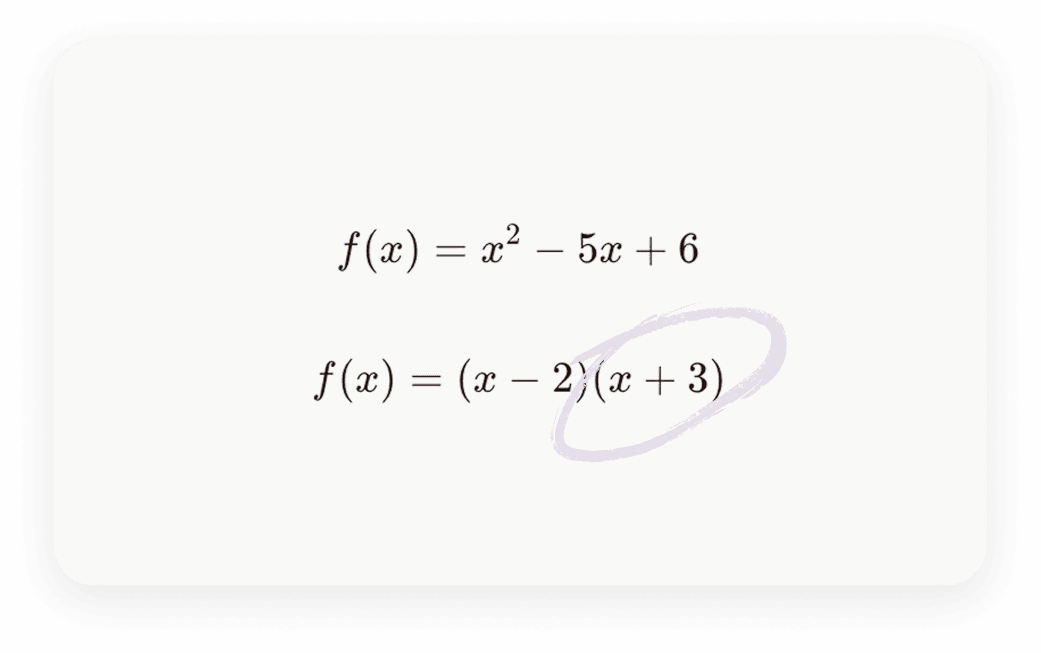
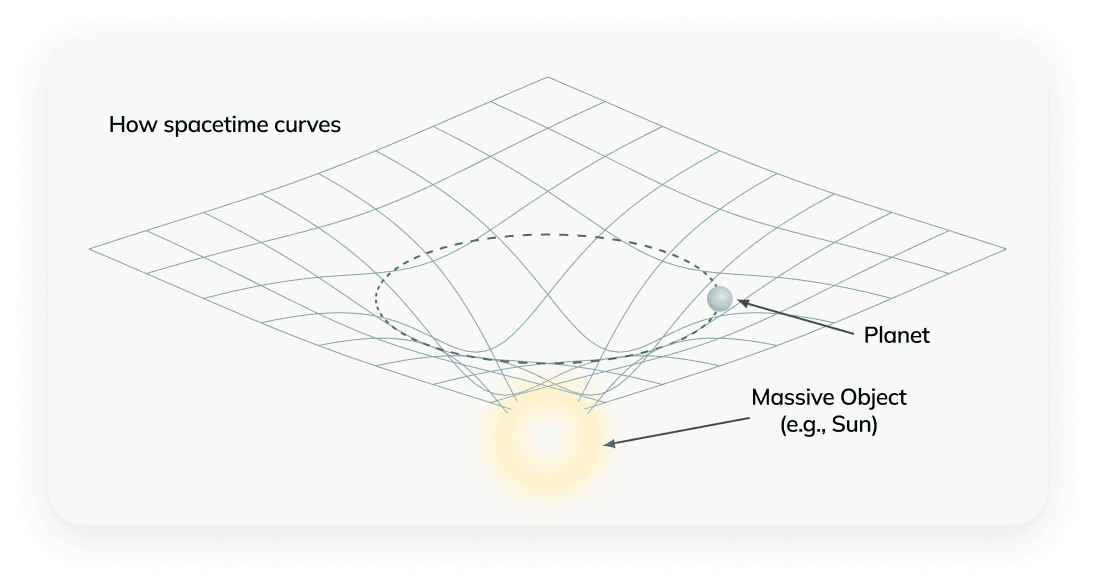
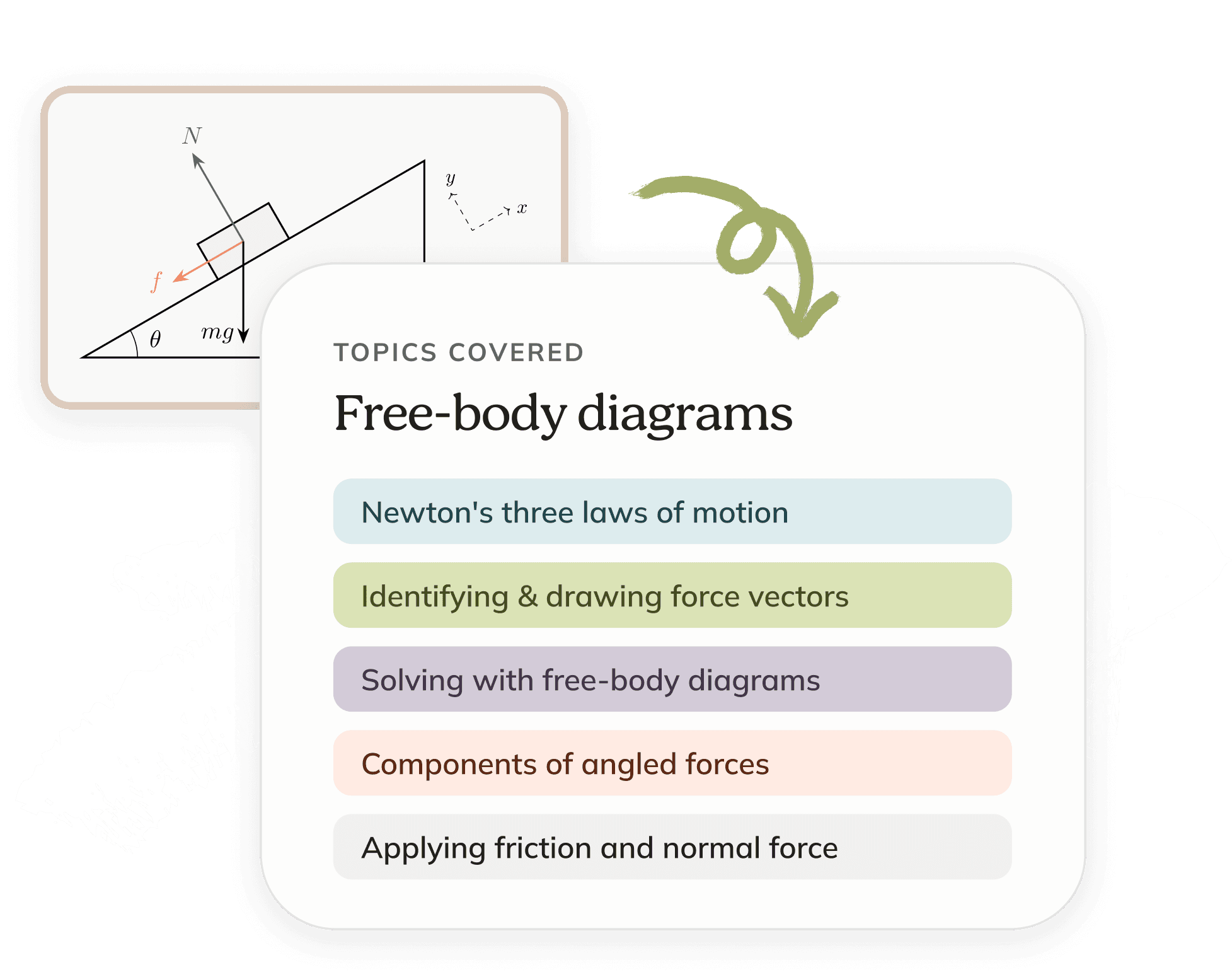
Aristotle draws steps, diagrams, and images to help you learn visually.
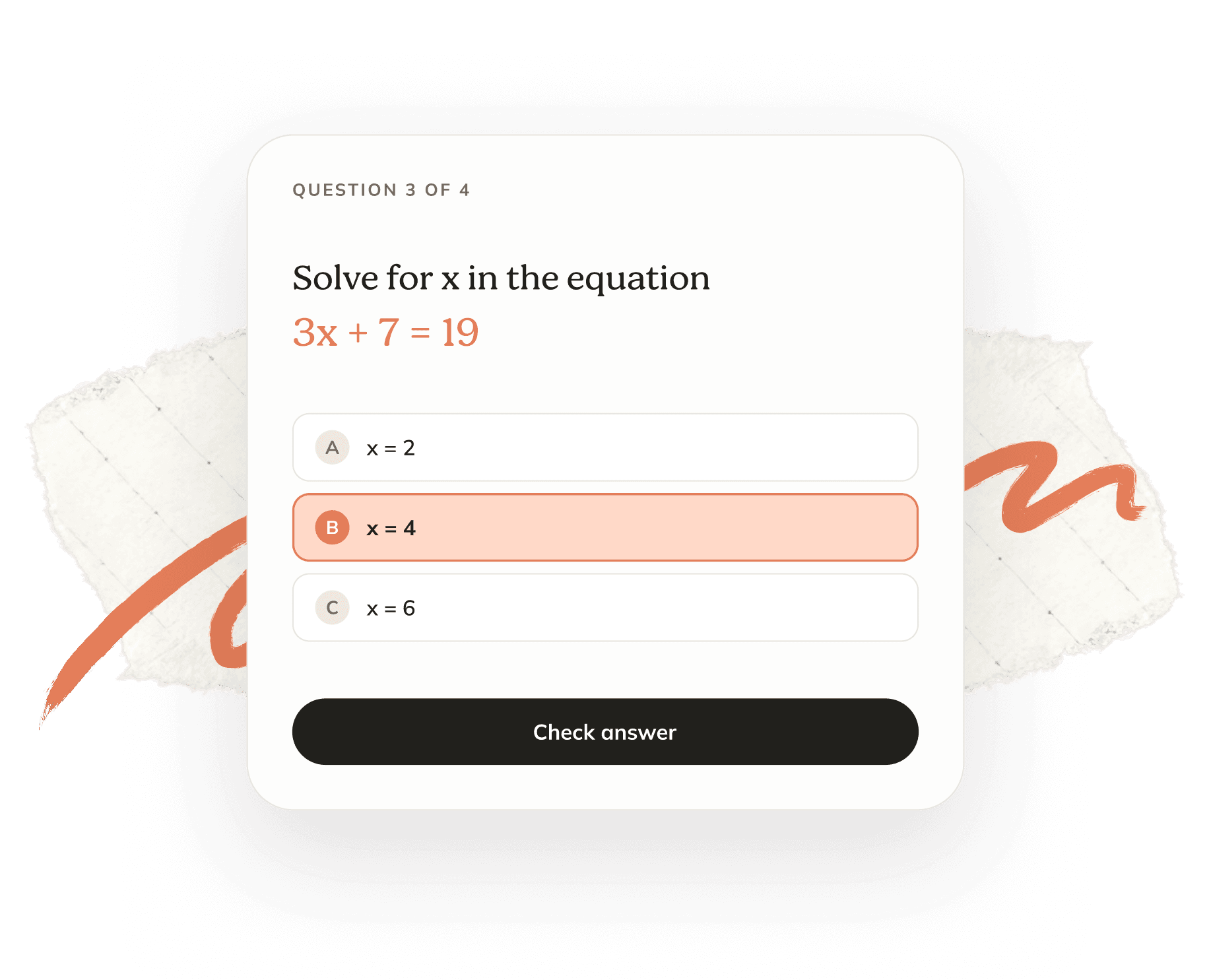
Get practice problems tailored to the exact topics you’re struggling with.
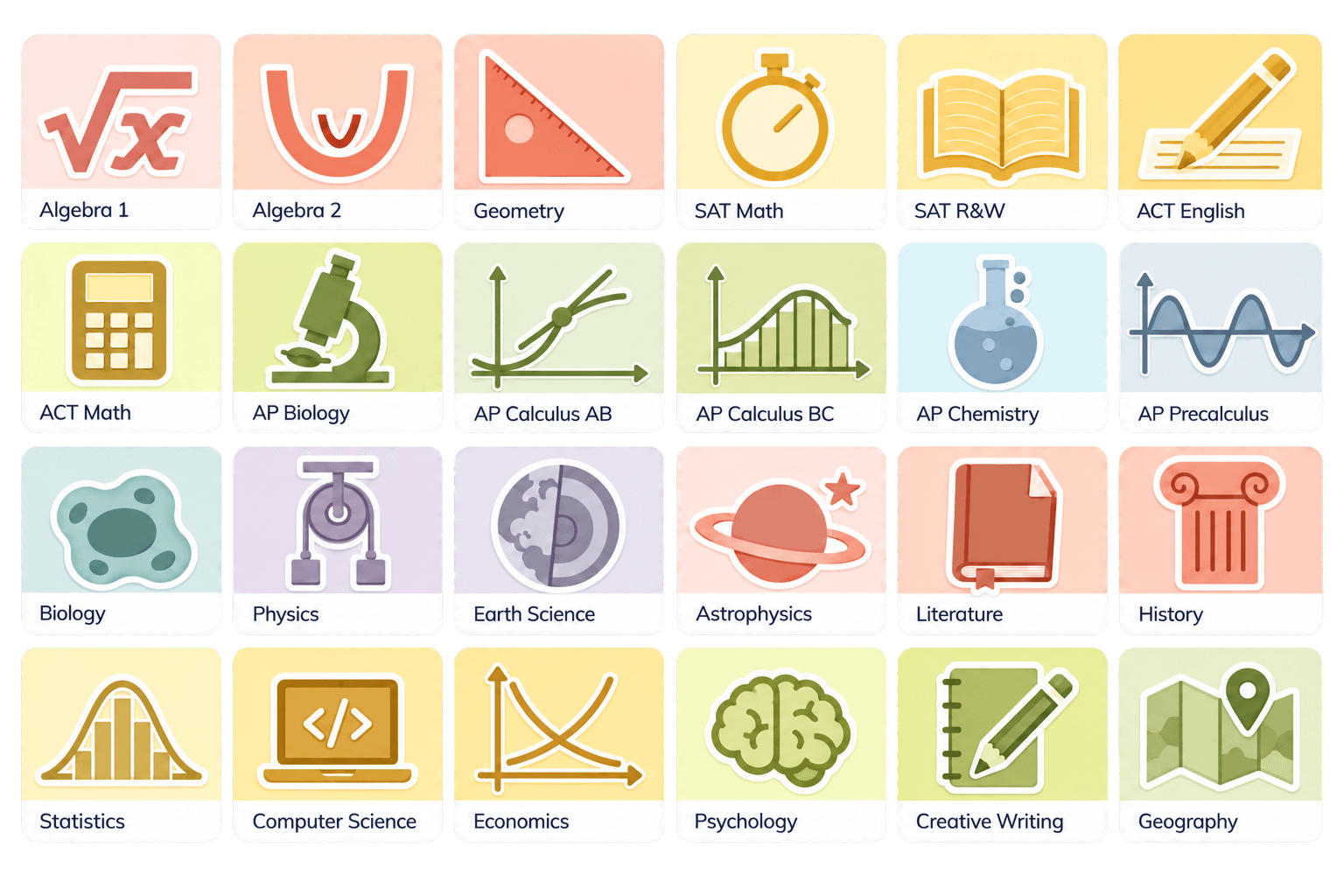
From middle-school math to AP exams to SAT/ACT prep. We also build custom plans matched to state standards and specific courses.
Revisit session summaries, session whiteboards, and uploads in one place.
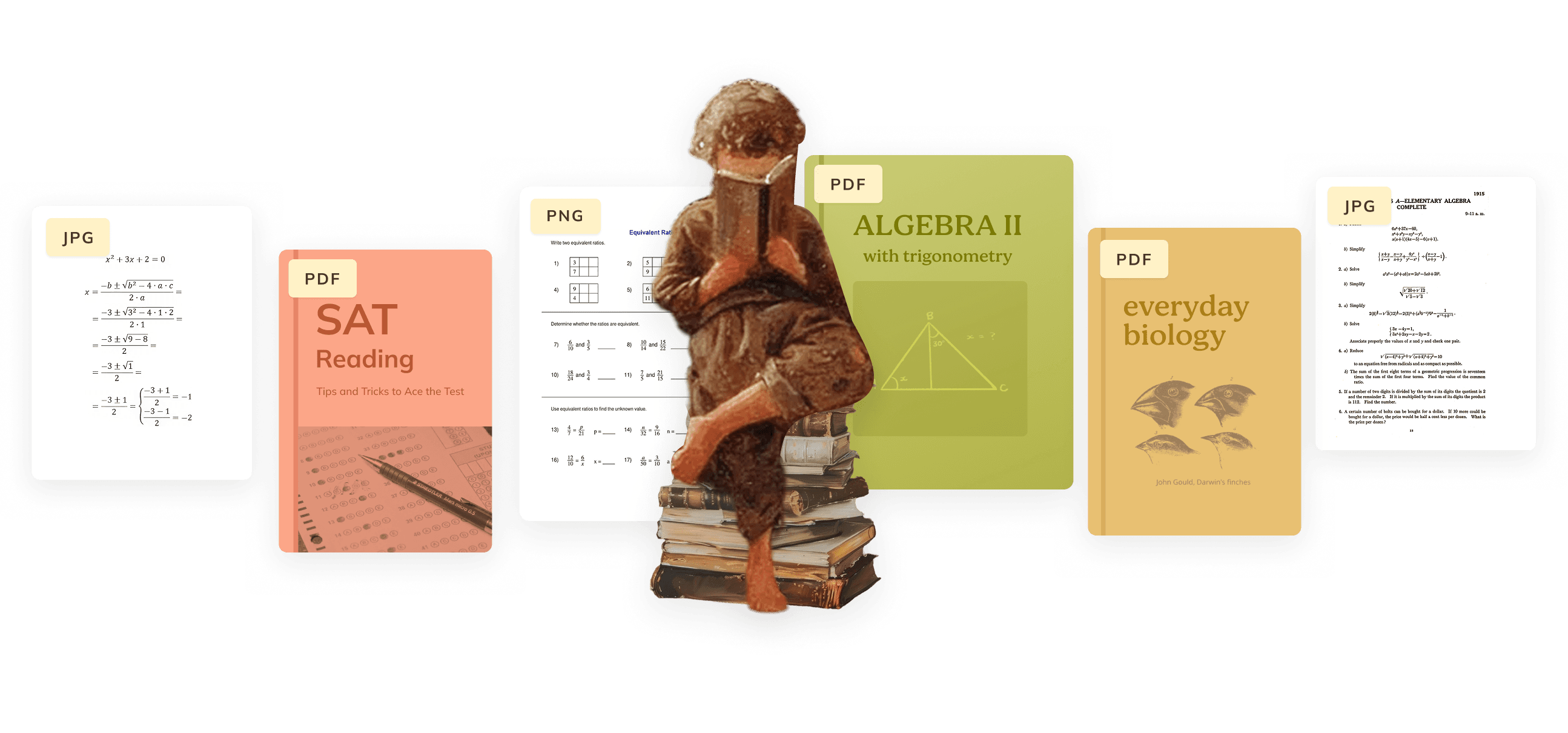
Aristotle can read and navigate any PDFs and images with the learner. That includes textbooks with hundreds of pages!
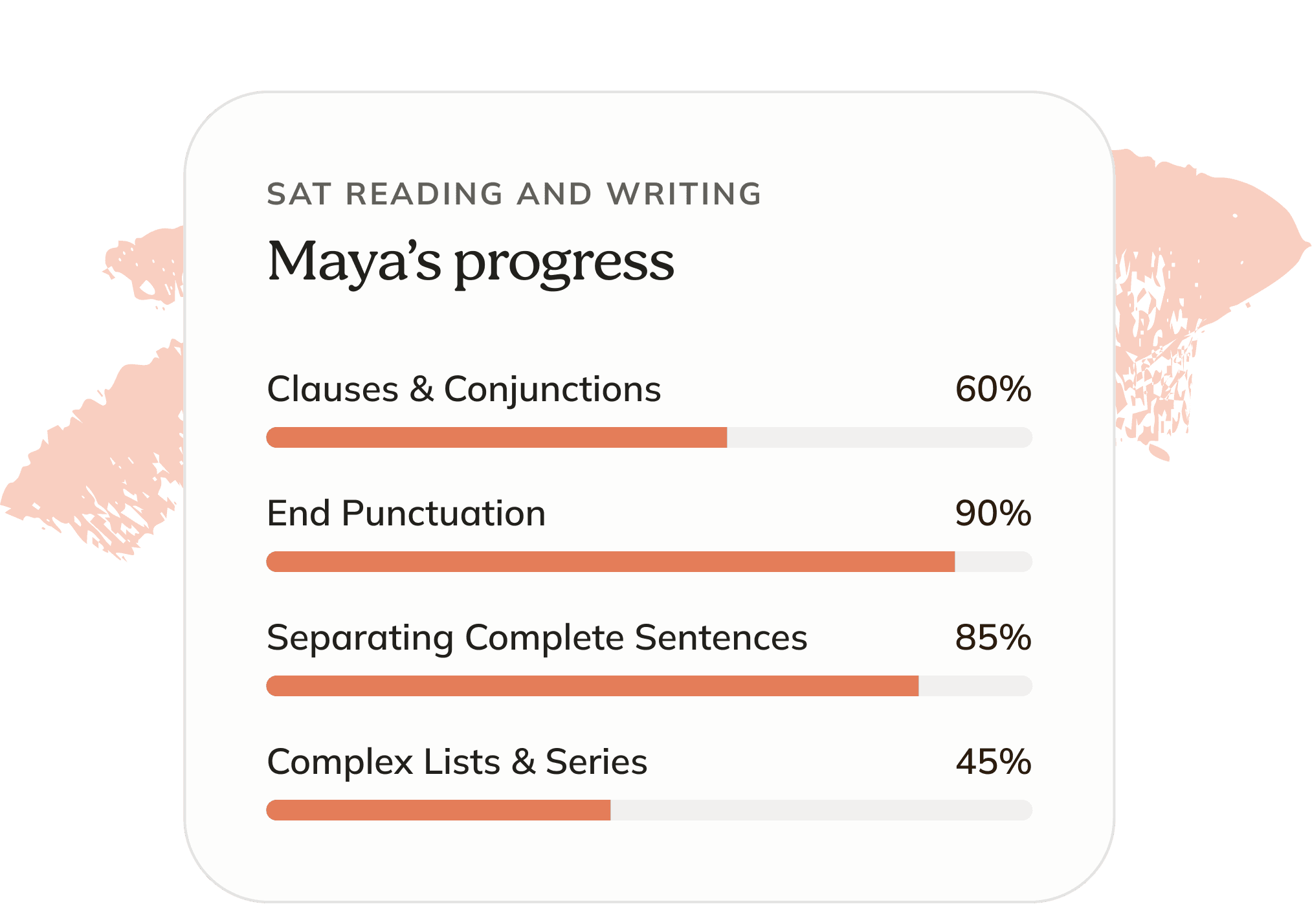
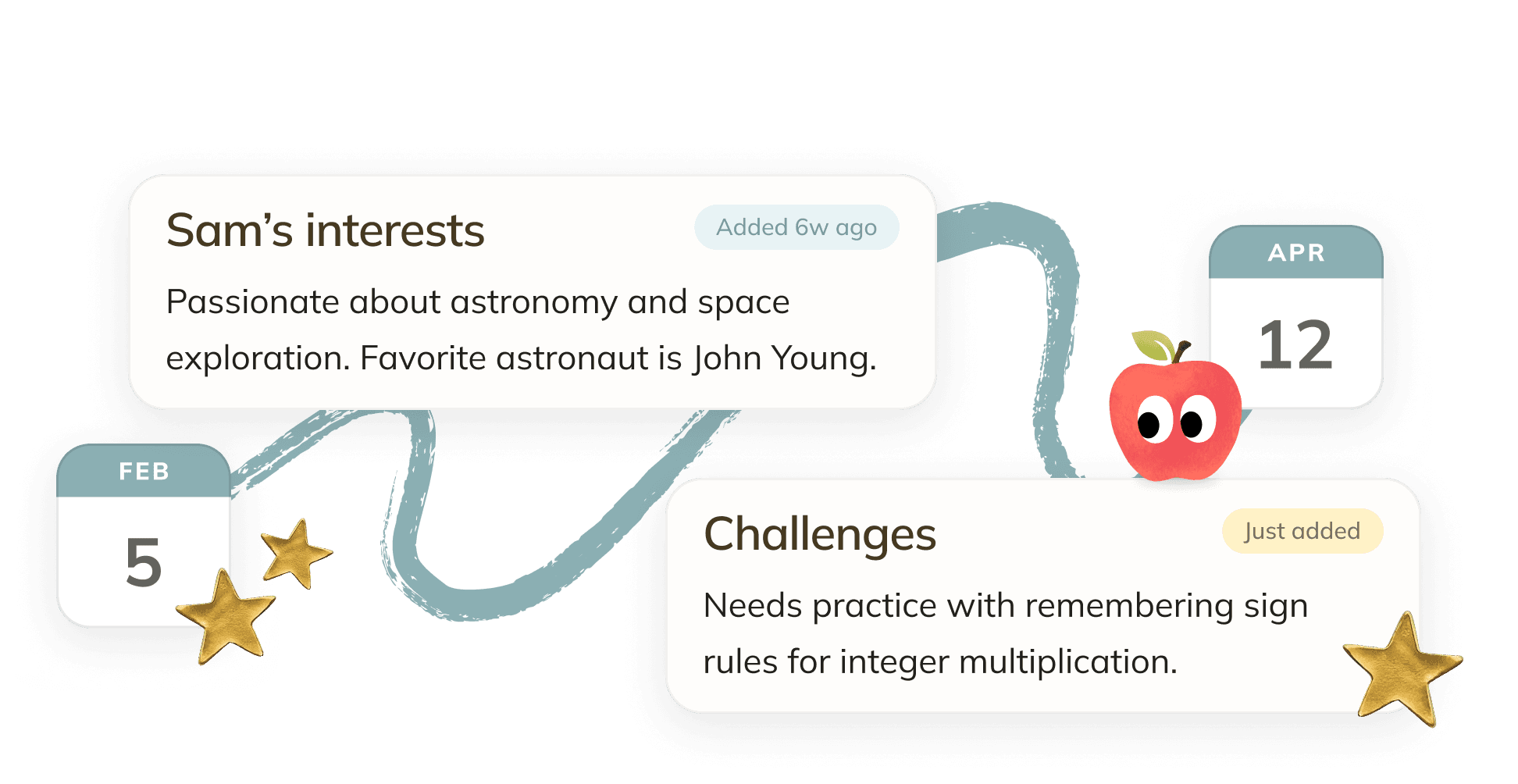
We break all subjects down into granular skills, then track mistakes and mastery on each one. Parents can see the whole picture at a glance.
Aristotle remembers every session: what you’ve covered, where you got stuck, how you like things explained. It picks up right where you left off.
The curriculum
Aristotle is designed to always know what to teach at exactly the right time.
Sample curriculum
+ 5 more math subjects available
* Click a topic to see the skills inside
Foundations for Algebra 1
Linear Equations
Linear Inequalities
Linear Functions
Statistics and Data Modeling
Linear Systems
Functions
Exponents and Radicals
Exponential Functions
Polynomials and Factoring
Quadratic Functions
Quadratic Equations
Algebra 1 tutoring curriculum372 skills across 12 units
Foundations for Algebra 1
Lean Algebra 1 on-ramp centered on algebraic expression language, expression evaluation, equivalent linear expressions, high-leverage arithmetic diagnostics, and unit reasoning. Topics: Algebraic Expression Language, Evaluating Expressions, Equivalent Linear Expressions, Algebra Readiness Arithmetic, Units and Dimensional Analysis.
Linear Equations
Solving linear equations in one variable: one- and two-step equations, multi-step solving past structural obstacles, literal-equation rearrangement, modeling contexts with a single equation, and absolute value equations. Topics: One-Step and Two-Step Equations, Multi-Step Linear Equations, Literal Equations and Formulas, Equation Modeling, Absolute Value Equations.
Linear Inequalities
Solving and graphing linear inequalities in one variable: one-step through multi-step solving with symbol reversal, compound inequalities and interval notation, modeling contexts with inequalities, and absolute value inequalities. Topics: Solving One-Variable Inequalities, Compound Inequalities and Interval Notation, Inequality Modeling, Absolute Value Inequalities.
Linear Functions
Linear relationships represented as functions, graphs, tables, rates of change, intercepts, proportional relationships, line-equation forms, and arithmetic sequences. Topics: Coordinate Plane and Graph Reading, Identifying Linear Relationships, Proportional Relationships and Unit Rates, Slope and Rate of Change, Intercepts, Forms of Linear Equations, Special Lines and Line Families, Arithmetic Sequences, Linear Modeling.
Statistics and Data Modeling
Statistics and data modeling: one-variable data, categorical data in two-way tables, scatter plots, trend lines, residuals, correlation, causation, sampling, measurement precision, and probability. Topics: One-Variable Data, Two-Way Tables and Categorical Data, Scatter Plots and Trend Lines, Residuals, Correlation, and Causation, Sampling, Bias, and Measurement Precision, Probability.
Linear Systems
Systems of linear equations and inequalities: graphing, substitution, elimination, special solution cases, modeling with multiple constraints, and feasible regions. Topics: Systems by Graphing, Solving by Substitution, Solving by Elimination, Special Systems, System Modeling, Two-Variable Linear Inequalities, Systems of Inequalities and Feasible Regions.
Functions
General function ideas used across Algebra 1: inputs and outputs, function notation, domain and range, graph features, sequences, inverse relationships, and connections among representations. Topics: Relations and Functions, Function Notation, Domain and Range, Interpreting Function Graphs, Sequences and Recursive Rules, Piecewise Functions, Absolute Value Functions, Inverse Functions.
Exponents and Radicals
Reusable algebraic fluency with powers, roots, scientific notation, radicals, rational exponents, and real-number structure that supports polynomial, exponential, and quadratic work. Topics: Zero and Negative Exponents, Exponent Rules, Scientific Notation, Square and Cube Roots, Rational and Irrational Numbers, Simplifying Radicals, Rational Exponents.
Exponential Functions
Exponential relationships represented as functions, tables, graphs, growth and decay models, and geometric sequences. Topics: Exponential Functions and Graphs, Exponential Growth and Decay, Geometric Sequences, Exponential Modeling, Simple Exponential Equations, Linear versus Exponential Change.
Polynomials and Factoring
Polynomial vocabulary, operations, special products, and factoring methods as expression-rewriting fluency; solving equations and graphing factored forms belong in the quadratic units. Topics: Polynomial Structure, Polynomial Operations, Special Products, Common Factors and Grouping, Factoring Quadratic Trinomials, Special Factoring Patterns, Factoring Strategy.
Quadratic Functions
Quadratic relationships as functions: recognizing quadratic patterns, graphing parabolas, interpreting features, using standard/factored/vertex forms to reveal graph behavior, transformations, and function modeling. Topics: Identifying Quadratic Relationships, Parabolas and Their Features, Quadratic Forms and Graphing, Quadratic Transformations, Quadratic Modeling.
Quadratic Equations
Quadratic equations as solution problems: finding inputs that satisfy quadratic equations by graphing, factoring, square roots, completing the square, the quadratic formula, discriminant reasoning, contextual solving, and linear-quadratic systems. Topics: Roots, Zeros, and Graphical Solutions, Solving by Factoring, Solving with Square Roots, Completing the Square, Quadratic Formula and Discriminant, Quadratic Modeling and Synthesis.
Geometry tutoring curriculum194 skills across 13 units
Foundations of Geometry
Lean on-ramp for the course: precise definitions and notation for points, lines, planes, segments, rays, and angles; segment and angle measurement and addition; coordinate midpoint and distance tools; angle pairs; and the core compass-and-straightedge tool constructions of the cross-cutting geo.construct.* family. Topics: Definitions and Notation, Segment Measurement, Angle Measurement, Angle Pairs, Coordinate Tools: Distance and Midpoint, Core Constructions.
Reasoning and Proof
Proof grammar practiced on easy content: conditional statements and their logical equivalents, inductive versus deductive reasoning, postulates and diagram conventions, and proof formats applied to algebraic, segment, and angle arguments. Topics: Conditional Statements and Logic, Proof Foundations and Formats.
Parallel and Perpendicular Lines
Transversal angle relationships and their proofs, criteria for proving lines parallel or perpendicular, and the coordinate side: slope criteria and equations of parallel and perpendicular lines, placed here with their conceptual basis ahead of the late Coordinate Geometry unit. Topics: Angles Formed by Transversals, Proving Lines Parallel, Perpendicular Lines, Slope Criteria and Equations of Lines.
Transformations
Rigid motions only: performing and describing translations, reflections, and rotations, the properties they preserve, compositions, symmetry, and congruence defined by rigid motions. Topics: Performing and Describing Rigid Motions, Compositions of Rigid Motions, Symmetry, Congruence via Rigid Motions.
Triangle Congruence
The first major synthesis: triangle angle theorems, congruence criteria (SSS, SAS, ASA, AAS, HL) justified by rigid motions, isosceles and equilateral triangle theorems, and congruence proofs with CPCTC. Topics: Triangle Angle Theorems, Congruence Criteria, Congruence Proofs.
Relationships in Triangles
Perpendicular and angle bisectors as loci, the four classical triangle centers, the midsegment theorem, and triangle inequality reasoning including the hinge theorem. Topics: Bisectors as Loci, Triangle Centers, Midsegments, Triangle Inequalities.
Quadrilaterals and Polygons
Polygon angle sums, parallelogram properties and proofs, special parallelograms, trapezoids and kites, and classification within the quadrilateral hierarchy. Topics: Polygon Angle Sums, Parallelograms, Rectangles, Rhombi, and Squares, Trapezoids and Kites, The Quadrilateral Hierarchy.
Similarity
The central relation changes from congruence to proportionality: dilations and their properties open the unit, then similarity defined via transformations, the AA/SSS/SAS criteria, proportionality theorems, and similar right triangles with geometric mean as the bridge into trigonometry. Topics: Dilations, Similar Figures and Criteria, Proportionality Theorems, Similar Right Triangles and Geometric Mean.
Right Triangles and Trigonometry
Pythagorean theorem and converse, special right triangles, and right-triangle trigonometry built on similarity, with elevation and depression applications. Topics: Pythagorean Theorem, Special Right Triangles, Right-Triangle Trigonometry, Trigonometry Beyond Right Triangles.
Circles
Central and inscribed angle relationships, chords, tangents, secants, segment products, circle proofs, arc length, sector area, and the radian connection, plus the circle constructions of the cross-cutting geo.construct.* family. Topics: Circle Vocabulary and Similarity, Angle and Arc Relationships, Chords, Tangents, and Segment Lengths, Circle Proofs, Arc Length, Sectors, and Radians, Circle Constructions.
Coordinate Geometry
The coordinate-methods unit: circle equations derived from the Pythagorean theorem, parabola focus and directrix work, partitioning directed segments, perimeter and area in the plane, and coordinate proofs that combine these tools with earlier figure properties. Topics: Equations of Circles, Parabolas from Focus and Directrix, Partitioning Segments, Coordinate Computations with Figures, Coordinate Proofs.
Solid Geometry and Measurement
Two-dimensional area including regular polygons and composites, cross sections and solids of revolution, volume formulas with informal derivations (including Cavalieri's principle), similar-solid scaling, and density and design modeling as the course's applications capstone. Topics: Area of Polygons and Composite Figures, Cross Sections and Solids of Revolution, Volume, Modeling with Geometry.
Probability
Conditional probability with sample spaces, events, independence, two-way tables, and the addition rule, plus geometric probability and counting methods as further extensions. Topics: Sample Spaces and Events, Independence and Conditional Probability, Geometric Probability and Counting.
Algebra 2 tutoring curriculum244 skills across 15 units
Foundations for Algebra 2
A diagnostic bridge from Algebra 1 that checks readiness in equation, inequality, function, and system fluency rather than re-teaching it, and introduces the new bridge content: solving linear systems in three variables and working with matrices. Topics: Algebraic Fluency, Function Fluency, Systems in Three Variables, Matrices.
Quadratics and Complex Numbers
Re-enters quadratics through what is new: the complex number system and its arithmetic, solving quadratics over the complex numbers, the discriminant over the complex numbers, completing the square as a structure tool, and systems pairing a line with a circle. Topics: Complex Number Arithmetic, Solving Quadratics over the Complex Numbers, Quadratic Structure and Forms, Linear-Quadratic Systems.
Polynomial Expressions and Equations
Polynomial arithmetic as a closed system, factoring at higher degree, polynomial long and synthetic division, the remainder and factor theorems, and solving polynomial equations. Topics: Polynomial Arithmetic and Identities, Higher-Degree Factoring, Polynomial Division and the Factor Theorem, Solving Polynomial Equations.
Polynomial Functions
Polynomials as relationships: classifying and graphing power and polynomial functions, end behavior, zeros and multiplicity, the factored-form-to-graph connection, the Fundamental Theorem of Algebra, and polynomial modeling. Topics: Polynomial Graph Shape and End Behavior, Zeros, Multiplicity, and Graphs, Polynomial Modeling and Interpretation.
Radicals and Rational Exponents
Deepens the Algebra 1 exponents-and-radicals toolkit: nth roots, rational-exponent fluency and justification, higher-index radical operations, square- and cube-root functions and graphs, and radical equations with extraneous-solution analysis. Topics: nth Roots and Rational Exponents, Radical Expression Operations, Radical Functions and Graphs, Radical Equations.
Rational Functions
Rational expressions as a system: simplifying and operating with excluded values, solving rational equations with extraneous-solution checks, graphing rational functions with their asymptotes, and inverse and joint variation. Topics: Rational Expression Arithmetic, Rational Equations, Rational Function Graphs and Asymptotes, Inverse and Joint Variation.
Functions and Transformations
A cross-family function toolkit placed before the exponential-logarithm arc because logarithms need inverse-function reasoning: transforming any function, even and odd functions, combining functions, inverse functions, and interpreting and comparing functions across representations. Topics: Transformations Across Families, Combining Functions, Inverse Functions, Interpreting and Comparing Functions.
Exponential Functions and Models
Re-enters Algebra 1 exponentials through what is new: non-integer inputs via rational exponents, rewriting exponential expressions to reveal equivalent rates, compound interest with multiple compounding periods, base e and continuous growth, and deeper exponential modeling. Topics: Exponential Structure and Rates, Base e and Continuous Growth, Exponential Modeling.
Logarithmic Functions
The logarithm as the inverse exponential: converting forms, evaluating, properties of logarithms, logarithmic graphs, solving exponential and logarithmic equations, and logarithmic applications. Topics: Logarithm Definition and Evaluation, Properties of Logarithms, Logarithmic Graphs, Exponential and Logarithmic Equations, Logarithmic Applications.
Sequences and Series
Deepens Algebra 1 sequence work and adds series: general explicit and recursive definitions, sequence modeling, sigma notation, finite arithmetic and geometric series, infinite geometric series, and the binomial theorem. Topics: Sequence Notation Deepened, Series and Sigma Notation, Binomial Theorem.
Trigonometric Functions
Trigonometry as functions: radian measure, the unit-circle extension of sine, cosine, and tangent, sinusoidal graphs and their parameters, periodic modeling, and the Pythagorean identity. Topics: Angles and Radian Measure, Right-Triangle Trigonometry On-Ramp, The Unit Circle, Sinusoidal Graphs, Periodic Modeling, The Pythagorean Identity.
Trigonometric Equations and Identities
Identity work beyond the Pythagorean identity, solving trigonometric equations, and the laws of sines and cosines. Topics: Trigonometric Identities, Trigonometric Equations, Laws of Sines and Cosines.
Probability
Conditional probability: describing events with set language, computing and interpreting conditional probability and independence, and the probability rules. Topics: Events and Set Language, Conditional Probability and Independence, Probability Rules, Counting Methods.
Statistical Inference
From description to inference: the normal distribution, study design, simulation and sampling variability, estimating with a margin of error, comparing treatments, and evaluating reports. Topics: The Normal Distribution, Study Design and Conclusions, Sampling, Simulation, and Margin of Error.
Conic Sections
The conic sections from their geometric definitions: circles and parabolas as distance-defined curves, ellipses and hyperbolas, classifying a conic from its equation, and solving nonlinear systems that involve them. Topics: Circles, Parabolas from Focus and Directrix, Ellipses and Hyperbolas, Classifying Conics and Nonlinear Systems.
Precalculus tutoring curriculum164 skills across 12 units
Algebra and Function Foundations
A lean diagnostic on-ramp covering the algebraic grammar precalculus assumes: real-number properties and notation, exponent and radical fluency, rewriting polynomial and rational expressions, and solving equations and inequalities. Topics: Real Numbers and Algebraic Properties, Exponents and Radicals, Polynomial and Rational Expressions, Solving Equations and Inequalities.
Functions and Their Graphs
The central object of the course: the coordinate plane and graphs of equations, lines and their slopes and forms, the definition and notation of functions, reading graph features, the library of parent functions, transformations, combinations and composition, and inverse functions. Topics: Coordinate Plane and Graphs, Linear Equations in Two Variables, Functions and Function Notation, Analyzing Graphs of Functions, Library of Parent Functions, Transformations of Functions, Combinations and Composition of Functions, Inverse Functions.
Polynomial and Rational Functions
Functions defined by polynomials and ratios of polynomials: quadratics and their graphs, the end behavior and zeros of higher-degree polynomials, polynomial division and the zero theorems, complex numbers, and the graphs, asymptotes, and inequalities of rational functions. Topics: Quadratic Functions, Polynomial Functions of Higher Degree, Polynomial and Synthetic Division, Complex Numbers, Zeros of Polynomial Functions, Rational Functions, Nonlinear Inequalities.
Exponential and Logarithmic Functions
The inverse pair of exponential and logarithmic functions: their graphs and key features, the definition of the logarithm, the properties used to rewrite logarithmic expressions, solving exponential and logarithmic equations, and growth, decay, and other models. Topics: Exponential Functions and Graphs, Logarithmic Functions and Graphs, Properties of Logarithms, Exponential and Logarithmic Equations, Exponential and Logarithmic Models.
Trigonometry
Trigonometry from angles to applications: angle measure in degrees and radians, the unit-circle and right-triangle definitions of the six trigonometric functions, trig functions of any angle, the graphs of all six functions and their inverses, and right-triangle and periodic applications. Topics: Angles and Their Measure, Trigonometric Functions: The Unit Circle, Right Triangle Trigonometry, Trigonometric Functions of Any Angle, Graphs of Sine and Cosine, Graphs of Other Trigonometric Functions, Inverse Trigonometric Functions, Applications and Models.
Analytic Trigonometry
Working symbolically with trigonometric expressions and equations: simplifying with the fundamental identities, verifying identities, solving trigonometric equations, and applying the sum and difference, double-angle, half-angle, and product-to-sum formulas. Topics: Using Fundamental Identities, Verifying Trigonometric Identities, Solving Trigonometric Equations, Sum and Difference Formulas, Multiple-Angle and Product-to-Sum Formulas.
Applications of Trigonometry
Trigonometry beyond the right triangle: solving oblique triangles with the Laws of Sines and Cosines, vector operations and the dot product in the plane, and the trigonometric (polar) form of complex numbers with DeMoivre's Theorem. Topics: Law of Sines, Law of Cosines, Vectors in the Plane, Vectors and Dot Products, Trigonometric Form of Complex Numbers.
Systems of Equations and Inequalities
Solving systems of equations and inequalities: linear and nonlinear systems by substitution, elimination, and Gaussian methods, decomposing rational expressions into partial fractions, and graphing systems of inequalities and solving linear programming problems. Topics: Two-Variable Systems, Multivariable Linear Systems, Partial Fractions, Systems of Inequalities and Linear Programming.
Matrices and Determinants
Matrix methods for linear systems: representing and row-reducing augmented matrices, matrix algebra, inverses for solving systems, determinants, and Cramer's Rule. Topics: Matrices and Systems of Equations, Operations with Matrices, Inverse of a Square Matrix, Determinants and Cramer's Rule.
Sequences, Series, and Probability
Discrete patterns and counting: sequence and series notation, arithmetic and geometric sequences and their sums, mathematical induction, the Binomial Theorem, counting principles, and basic probability. Topics: Sequences and Series, Arithmetic Sequences and Series, Geometric Sequences and Series, Mathematical Induction, The Binomial Theorem, Counting and Probability.
Analytic Geometry: Conics, Parametric, and Polar
Curves in the plane beyond function graphs: the conic sections and their equations, rotation of axes, parametric representations of curves, and polar coordinates with the graphs and conic equations they enable. Topics: Parabolas, Ellipses, Hyperbolas, Rotation of Conics, Parametric Equations, Polar Coordinates and Graphs.
Limits and the On-Ramp to Calculus
An introduction to the limit concept that motivates calculus: estimating limits graphically and numerically, evaluating them algebraically, and using limits to find instantaneous rate of change as the slope of a tangent line and to approximate the area under a curve. Topics: Introduction to Limits, Limits and Rates of Change.
AP Calculus AB tutoring curriculum142 skills across 8 units
Limits and Continuity
AP Calculus AB exam weighting: 10-12%. Topics: Introducing Calculus: Can Change Occur at an Instant?, Defining Limits and Using Limit Notation, Estimating Limit Values from Graphs, Estimating Limit Values from Tables, Determining Limits Using Algebraic Properties of Limits, Determining Limits Using Algebraic Manipulation, Selecting Procedures for Determining Limits, Determining Limits Using the Squeeze Theorem, Connecting Multiple Representations of Limits, Exploring Types of Discontinuities, Defining Continuity at a Point, Confirming Continuity over an Interval, Removing Discontinuities, Connecting Infinite Limits and Vertical Asymptotes, Connecting Limits at Infinity and Horizontal Asymptotes, Working with the Intermediate Value Theorem (IVT).
Differentiation: Definition and Fundamental Properties
AP Calculus AB exam weighting: 10-12%. Topics: Defining Average and Instantaneous Rates of Change at a Point, Defining the Derivative of a Function and Using Derivative Notation, Estimating Derivatives of a Function at a Point, Connecting Differentiability and Continuity: Determining When Derivatives Do and Do Not Exist, Applying the Power Rule, Derivative Rules: Constant, Sum, Difference, and Constant Multiple, Derivatives of cos x, sin x, ex, and ln x, The Product Rule, The Quotient Rule, Finding the Derivatives of Tangent, Cotangent, Secant, and/or Cosecant Functions.
Differentiation: Composite, Implicit, and Inverse Functions
AP Calculus AB exam weighting: 9-13%. Topics: The Chain Rule, Implicit Differentiation, Differentiating Inverse Functions, Differentiating Inverse Trigonometric Functions, Selecting Procedures for Calculating Derivatives, Calculating Higher - Order Derivatives.
Contextual Applications of Differentiation
AP Calculus AB exam weighting: 10-15%. Topics: Interpreting the Meaning of the Derivative in Context, Straight-Line Motion: Connecting Position, Velocity, and Acceleration, Rates of Change in Applied Contexts Other Than Motion, Introduction to Related Rates, Solving Related Rates Problems, Approximating Values of a Function Using Local Linearity and Linearization, Using L’Hospital’s Rule for Determining Limits of Indeterminate Forms.
Analytical Applications of Differentiation
AP Calculus AB exam weighting: 15-18%. Topics: Using the Mean Value Theorem, Extreme Value Theorem, Global Versus Local Extrema, and Critical Points, Determining Intervals on Which a Function Is Increasing or Decreasing, Using the First Derivative Test to Determine Relative (Local) Extrema, Using the Candidates Test to Determine Absolute (Global) Extrema, Determining Concavity of Functions over Their Domains, Using the Second Derivative Test to Determine Extrema, Sketching Graphs of Functions and Their Derivatives, Connecting a Function, Its First Derivative, and Its Second Derivative, Introduction to Optimization Problems, Solving Optimization Problems, Exploring Behaviors of Implicit Relations.
Integration and Accumulation of Change
AP Calculus AB exam weighting: 17-20%. Topics: Exploring Accumulationsof Change, Approximating Areas with Riemann Sums, Riemann Sums, Summation Notation, and Definite Integral Notation, The Fundamental Theorem of Calculus and Accumulation Functions, Interpreting the Behavior of Accumulation Functions Involving Area, Applying Properties of Definite Integrals, The Fundamental Theorem of Calculus and Definite Integrals, Finding Antiderivatives and Indefinite Integrals: Basic Rules and Notation, Integrating Using Substitution, Integrating Functions Using Long Division and Completing the Square, Selecting Techniques for Antidifferentiation.
Differential Equations
AP Calculus AB exam weighting: 6-12%. Topics: Modeling Situations with Differential Equations, Verifying Solutions for Differential Equations, Sketching Slope Fields, Reasoning Using Slope Fields, Finding General Solutions Using Separation of Variables, Finding Particular Solutions Using Initial Conditions and Separation of Variables, Exponential Models with Differential Equations.
Applications of Integration
AP Calculus AB exam weighting: 10-15%. Topics: Finding the Average Value of a Function on an Interval, Connecting Position, Velocity, and Acceleration of Functions Using Integrals, Using Accumulation Functions and Definite Integrals in Applied Contexts, Finding the Area Between Curves Expressed as Functions of x, Finding the Area Between Curves Expressed as Functions of y, Finding the Area Between Curves That Intersect at More Than Two Points, Volumes with Cross Sections: Squares and Rectangles, Volumes with Cross Sections: Triangles and Semicircles, Volume with Disc Method: Revolving Around the x- or y-Axis, Volume with Disc Method: Revolving Around Other Axes, Volume with Washer Method: Revolving Around the x- or y-Axis, Volume with Washer Method: Revolving Around Other Axes.
My son told me yesterday that we should cancel his human tutor, because Aristotle is doing a better job. The human tutor was $250/hour.

A few things you might wonder before getting started.
Aristotle tutors the full grades 6–12 math sequence: pre-algebra foundations, Algebra 1, Geometry, Algebra 2, Precalculus, and AP Calculus, plus SAT and ACT math prep. Every course is built on a curriculum map of more than 1,100 individually tracked skills, so the tutor always knows what your child has mastered and what comes next.
Check out our most recent blog posts.
This could be you
For homework, supporting your child, or anything you’ve always wanted to know more about, Aristotle makes it easy for anyone to learn out loud.