Blog
AI Tutors That Guide Instead of Giving Answers: What a Socratic AI Tutor Does
For parents of middle and high school students
A Socratic AI tutor teaches by asking guiding questions, so the student works out each step instead of copying a finished answer. Aristotle is built this way, and parents can test any helper with a few simple checks before trusting it with homework.
What is a Socratic AI tutor?
The Socratic method is teaching through questions that lead a student to reason out an idea, rather than stating it for them. A Socratic AI tutor applies that to schoolwork. It listens to what the student has already tried, then asks the next question that moves the work forward. Aristotle is a voice AI tutor designed around that loop. Students have completed more than 5,000 sessions and 100,000 minutes of tutoring with it.
That is a different job from a chatbot that returns a worked solution when you paste a problem. We wrote about that gap in Why AI chatbots make bad tutors and in Funneling vs. focusing.
How is guiding different from giving answers?
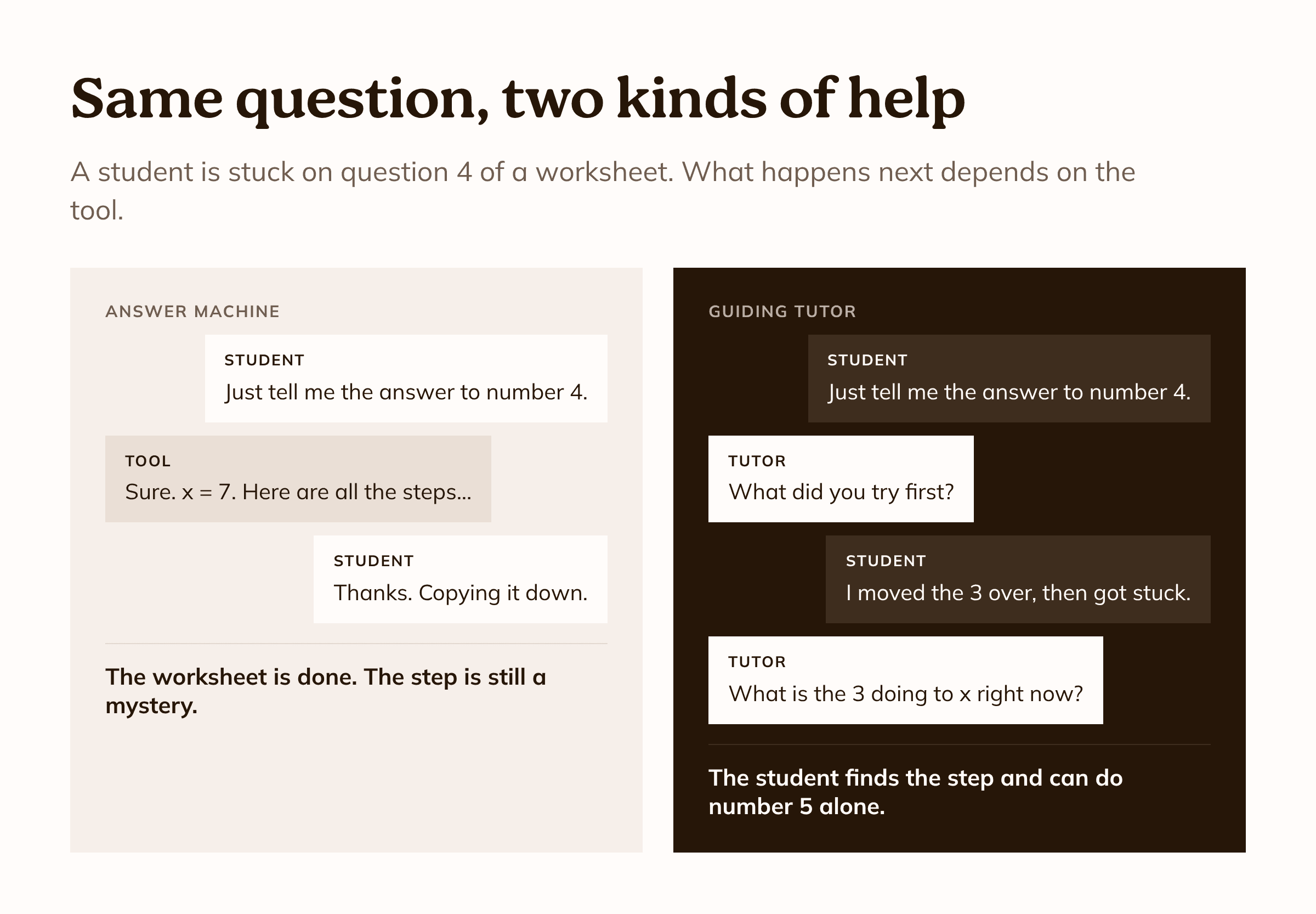
Giving the answer finishes the worksheet. Guiding leaves the reasoning with the student. The tutor may restate the problem, ask what the first step is, or point at the place the work went sideways. It does not hand over the last line.
A session that guides takes longer per problem. That extra time is the tutoring. A student who can explain the step can do the next problem without the tool. A student who copied the solution often cannot.
What does a guiding exchange sound like?
Here is a short exchange about planning, not a solved homework problem.
Student: I have a paper due Friday and I keep opening a blank document.
Tutor: What is the paper supposed to decide?
Student: Whether the main character changed or just got lucky.
Tutor: If you had to pick a side tonight, which two scenes would you use?
The tutor did not outline the essay. It asked the student to name a decision and the evidence they would actually use. That is the pattern to look for: the student is still doing the thinking.
How often do tutors hand over the answer?
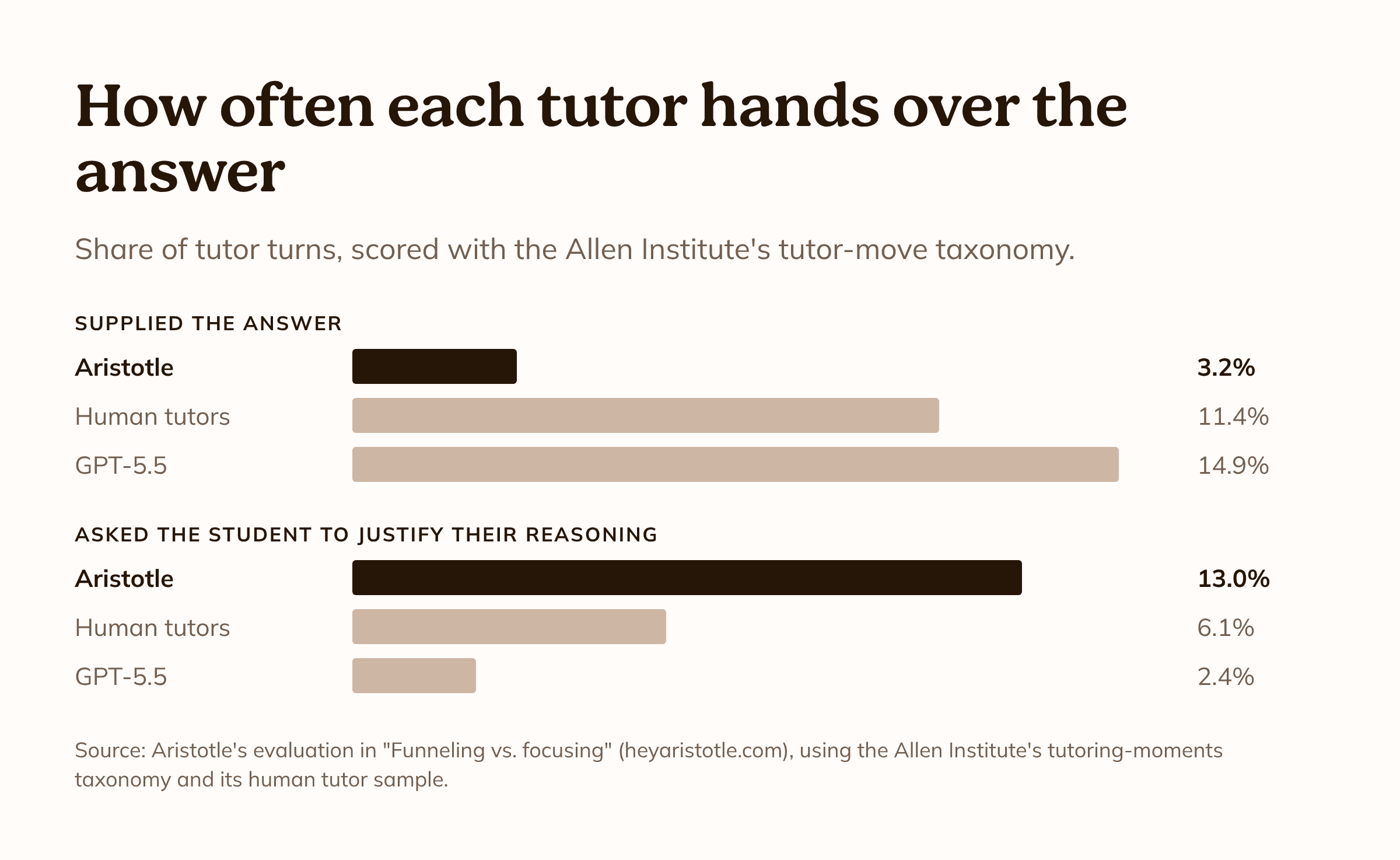
We measured this. Scored with the Allen Institute's tutor-move taxonomy, Aristotle supplied the answer on 3.2% of turns. Human tutors in the Allen Institute's sample did on 11.4%, and GPT-5.5 on 14.9%. Aristotle asked students to justify their reasoning on 13% of turns, against 6.1% for human tutors. The full method is in Funneling vs. focusing.
How can parents test whether a helper guides or answers?
You can run this in a few minutes on any tool, including Aristotle.
- Ask for the answer outright. Paste a problem or type "just tell me the answer." A guiding tutor asks what the student has already tried.
- Stay silent after the first reply. If the tool keeps talking until the solution is on the screen, it is doing the work.
- Try a planning prompt. Ask how to start an assignment without giving the topic details. A guiding tutor asks what the assignment is asking the student to decide.
- Check what you can see later. Parents should be able to review how the session went. On Aristotle, session summaries go to parents. Read how we handle safety.
Which AI tools are designed to guide?
This is not a ranking. Each cell is what that product's own public site said on October 26, 2026.
| Tool | Designed to withhold final answers? | How students interact | Source |
|---|---|---|---|
| Khanmigo | Designed to withhold final answers?Yes. Khan Academy says it never gives the answer and guides learners to find it. | How students interactTalk or type. Speech-to-text and text-to-speech are built in. | Sourcekhanmigo.ai/learners |
| Socra | Designed to withhold final answers?Yes. The site says it uses Socratic questioning instead of a finished answer to memorize. | How students interactType, speak, or snap a photo, then enter a guided dialogue. | Sourcehisocra.com |
| Aristotle | Designed to withhold final answers?Yes. It guides with questions and does not give the answer outright. | How students interactLive voice on a shared whiteboard. | Sourceheyaristotle.com/ai-tutor |
When is a direct answer the right call?
Sometimes the student already did the reasoning and needs a check. A definition after they have tried to state it, a confirmation that a step is legal, or a fact they would look up in a book can be the right move. Safety questions and logistics ("when is the assignment due?") are not tutoring problems.
A direct answer is the wrong call when it replaces the work the teacher assigned. If the helper will finish the problem while the student watches, pick a different tool. See how Aristotle teaches.
Get started today — we’d love for you to meet Aristotle yourself.
Questions parents ask
Does an AI tutor that doesn't give answers slow students down?
It can take longer per problem, because the student does the reasoning. That reasoning is the point of tutoring.
What is the Socratic method in tutoring?
Teaching through questions that lead a student to reason out an idea, rather than stating it for them.
Will Aristotle ever just tell my child the answer?
No. Aristotle guides with questions and hints. It does not give the answer outright.
How do I check if an AI app is doing homework for my child?
Ask it for the answer to a problem directly and see whether it asks what the student has tried first.