Research
Funneling vs. Focusing: How Aristotle manages cognitive load
How Aristotle uses learning science to best LLMs (and even human tutors) at managing cognitive load.
In 1945, the mathematician George Pólya compressed the craft of teaching into a single sentence: “The teacher should help, but not too much and not too little, so that the student shall have a reasonable share of the work.”
The history of learning science has echoed Pólya’s proclamation. The zone of proximal development (Vygotsky, 1978), scaffolding (Wood et al., 1976), productive struggle (Kapur, 2008) and desirable difficulty (Bjork and Bjork, 2020) all position teaching as a balance of support and challenge: helping not too much and not too little.
At Aristotle, we want to bridge the gap between these proven, yet abstract, learning science concepts and practice. We’ve oriented our research around the concept of cognitive load — ensuring that in every interaction, our tutor is providing just the right amount of support and challenge through its questions, lesson organization, and pacing (Sweller, 1988). The goal is not to lighten that load but to hold it steadily on the student’s shoulders, to aim it at the muscles that build understanding, and to set it at a weight they can actually carry (Sweller, van Merriënboer & Paas, 1998).
Funneling vs. Focusing
AI tutors and chatbots tend to get this balance wrong: offering too much support and not enough challenge. This mirrors a well-documented pattern in real-world teaching: funneling and focusing.
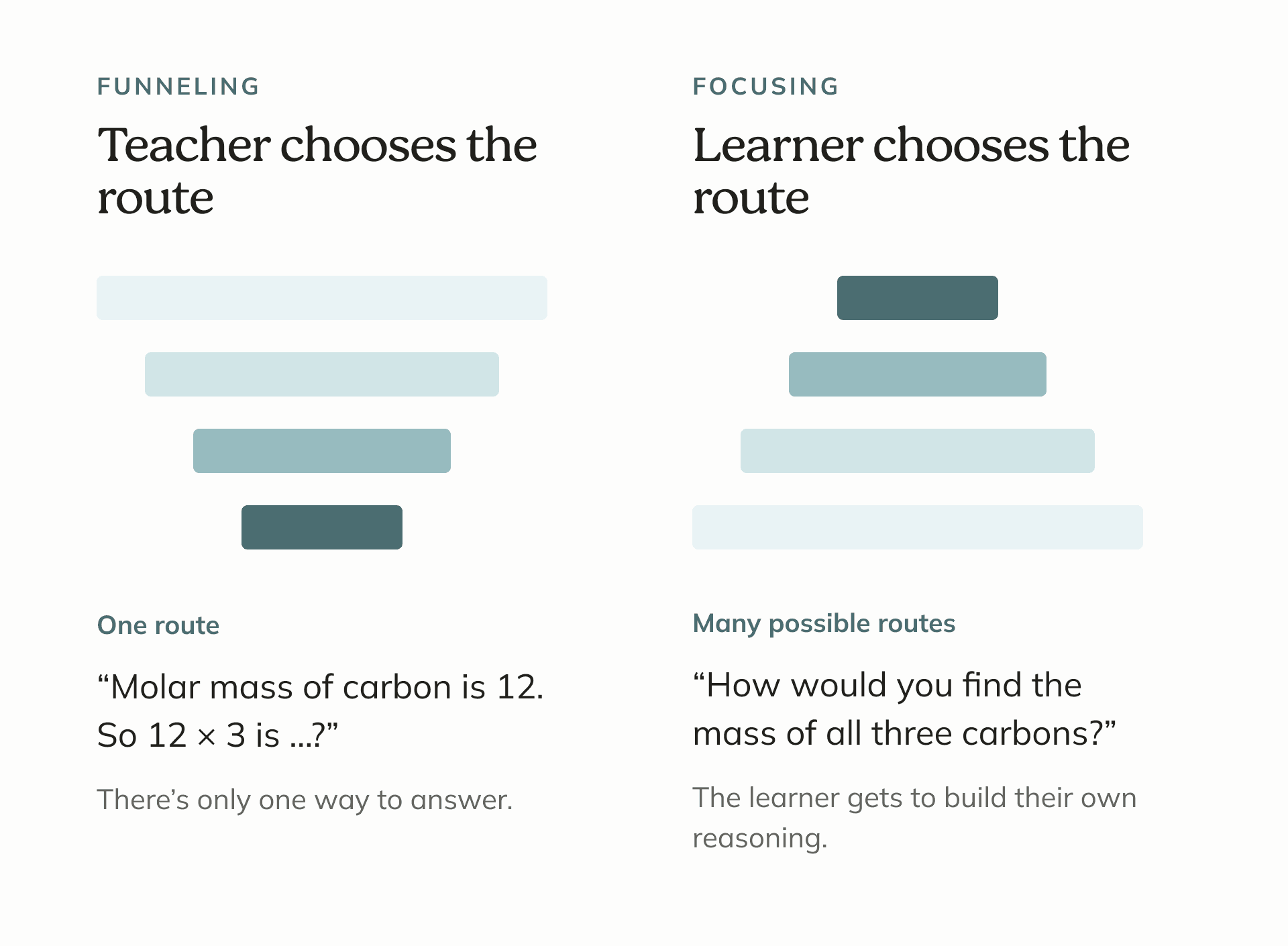
When a student is in need of assistance, teachers’ questions follow one of two opposing shapes (Wood, 1998). A teacher can ask a funneling question, narrowing the student’s response to execute the teacher’s reasoning (Herbel-Eisenmann & Breyfogle, 2005). These questions funnel students towards a normative answer by decomposing a problem and turning a rich learning opportunity into a fill-in-the-blank.
Conversely, teachers can use focusing questions and place the responsibility of sense-making back onto the student. These open-ended questions focus the cognitive load on the student and stimulate deeper thinking and reflection. Researchers found that teaching via focusing questions is linked to better student learning outcomes and confidence in mathematics (Hagenah et al., 2018; Franke and Kazemi, 2001).
| Funneling | Focusing |
|---|---|
| Do you do the multiplication first or the addition first in PEMDAS? | Why does the order in which we solve this expression matter? |
| So that cancels, and you’re left with what? | What do you notice about the top and the bottom? |
| We balance the oxygen atoms first, right? | What’re your options for balancing here? |
| Molar mass of carbon is 12. So 12 times 3 is? | How would you find the mass of all three carbons? |
| Now just add 7 to both sides — what do you get? | In your own words, what’s the problem asking you to do here? |
This distinction may seem subtle, but it can be the difference between a student actively learning and complete cognitive offloading.
LLMs (and humans) love funneling
Frontier LLM models are masters of funneling, consistently reducing cognitive load on learners (Zheng et al., 2024; Maiya et al., 2025). In research, this exceedingly supportive tendency of AI models has improved students’ performance on AI-supported practice, while leading to worse student performance without the AI (Bastani et al., 2025).
LLM training that incentivizes helpfulness is not aligned with desirable teaching, where the goal is not to always offer maximum support, but instead to provide the right assistance at the right moment. This LLM behavior leads to deskilling, over-reliance, and cognitive offloading behaviors for students (Padmakumar et al., 2026; Ibrahim et al., 2026).
LLMs are not the only guilty party when it comes to funneling. In a recent Allen Institute study, human tutors over-helped on more than 50% of their speaking turns and pushed students for deeper understanding in fewer than 1 in 5 eligible moments. Even the best human tutors struggle with the treacherous balance of cognitive load.
How we built Aristotle to be different
To succeed where humans and LLMs fall short, Aristotle offers a degree of support optimized against the evidenced need of the student. If a student is working through a problem successfully and independently, Aristotle has no trouble letting them continue. When a student is struggling or verbalizes a misconception, Aristotle asks focusing questions.
Only after unproductive struggle does Aristotle begin to shift the balance of cognitive load. Given repeated mistakes or clear gaps in understanding, Aristotle moves from focusing questions to productive funneling and real instruction. Unlike LLMs, and even some human tutors, we built Aristotle to never ask fill-in-the-blank questions.
Likewise, a good tutor must keep track of when they lightened a student’s cognitive load, to not claim false mastery. When assistance is needed and Aristotle provides help, Aristotle knows to follow up on that concept later and test the student’s independent ability. Without this “assistance ledger”, a student could progress through content via funneling and never demonstrate real understanding.
So, how does Aristotle compare?
Being “backed by research” and “pedagogically aligned” only matters if Aristotle performs in practice. In the tutoring industry there is a clear benchmarking gap. Despite this, we have found ways to empirically evaluate Aristotle’s pedagogical quality. After implementing our new cognitive load protocol, Aristotle now asks funneling questions at 1/3 of its previous rate.
Additionally, student/tutor word share can be used as a quantitative stand-in for cognitive load management. Our new protocol reduced tutor words per turn by 22%, allowing the student to take on more cognitive load and agency in their session.
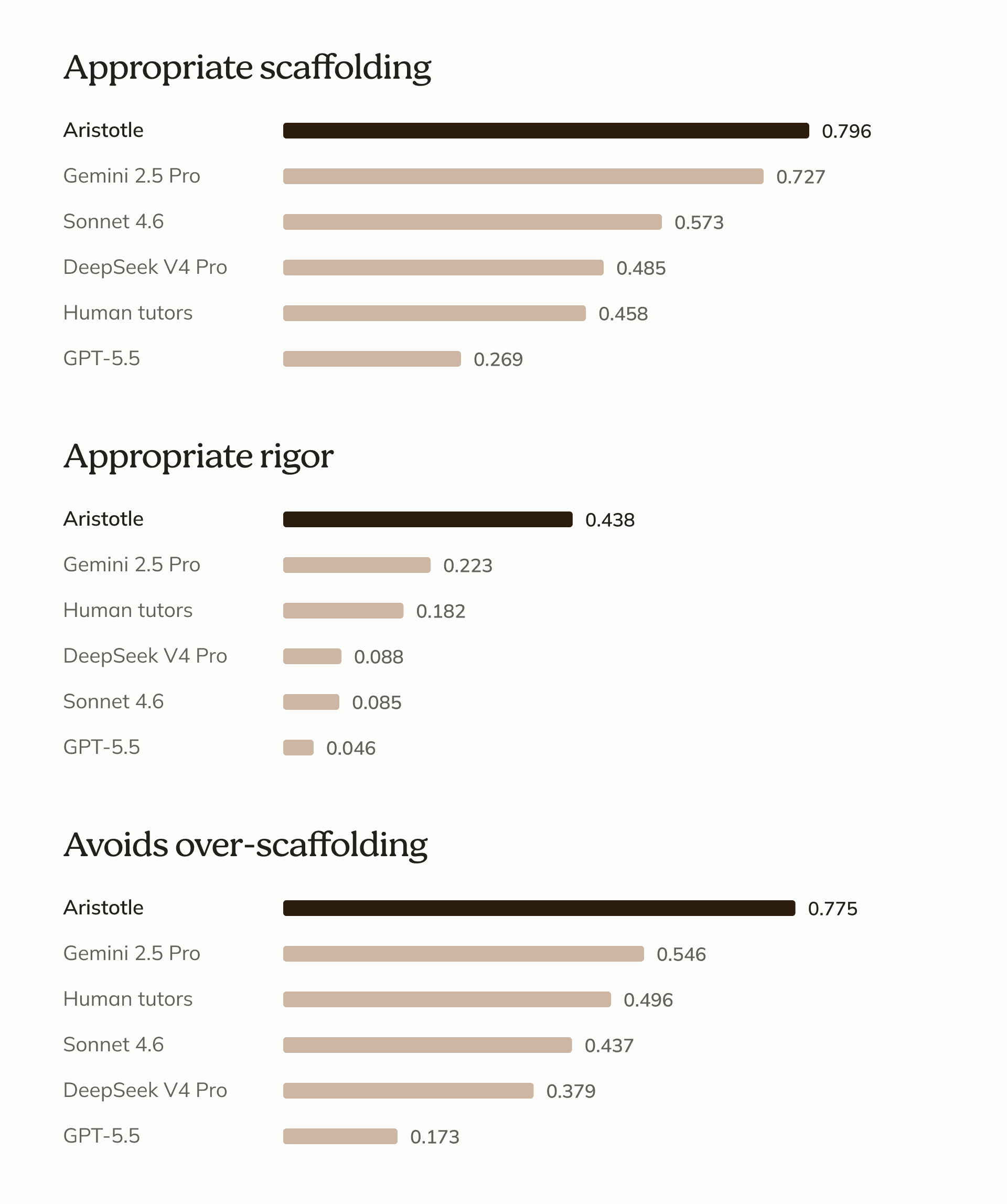
Using the Allen Institute paper on effective tutoring, we were able to evaluate Aristotle compared to both standard LLMs and human tutors from their sample. Aristotle treads the line of both providing adequate scaffolding and pushing the learner at significantly higher rates than human tutors and the leading AI models.
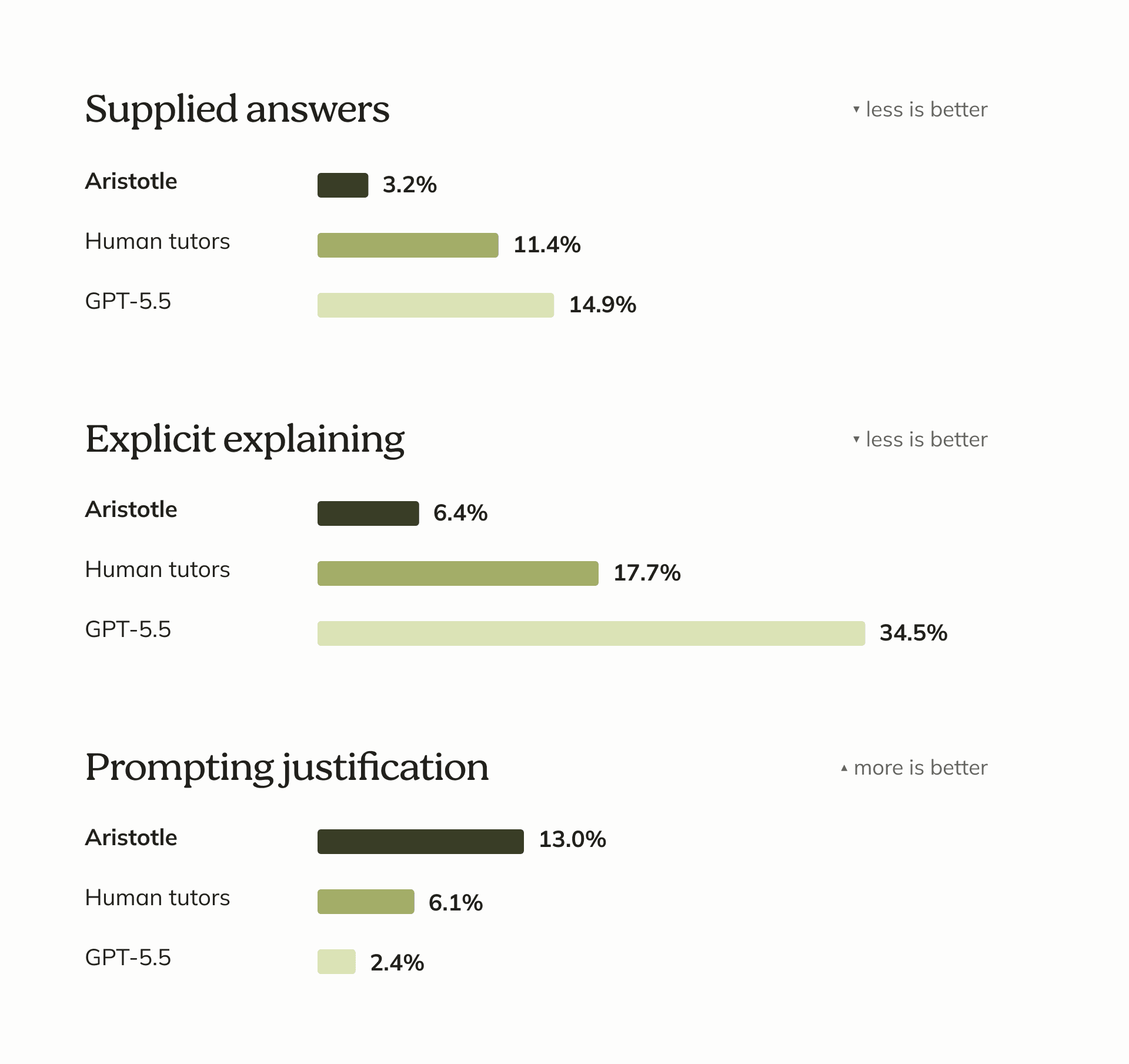
The Allen Institute also released a tutor move taxonomy, allowing different tutors’ behavior to be compared across consistent axes. Using this taxonomy, Aristotle “supplied answers” on 3.2% of turns (human tutors at 11.4%) and spent less time explicitly explaining content (6.4% vs. 17.7% for human tutors). By minimizing these funneling behaviors, Aristotle increases cognitive load for the student to a more healthy amount. This is evidenced by Aristotle “prompting justification” from students on 13% of turns as opposed to human tutors’ 6.1% and GPT-5.5’s 2.4%.
At Aristotle, we’re incredibly proud of these results — further proof that we are optimizing for real learning instead of pure helpfulness. By minimizing funneling and other cognitive load thievery, we move one step closer to building the best tutor in the world.