Blog
How to Choose an AI Tutor: A Parent's Checklist
For parents of middle and high school students
To choose an AI tutor, check how it teaches (guiding questions versus handing out answers), what safety and parent controls it has, which subjects it covers, and whether you can try it free. This checklist works for any tool, including Aristotle.
What should an AI tutor actually do?
An AI tutor works through school material with a student one-on-one, by text or voice, and adjusts to their answers. It should keep the student doing the thinking. If it returns a finished solution the moment a problem is pasted in, it is a homework helper, not a tutor. That difference is the subject of Why AI chatbots make bad tutors.
Aristotle is built to guide with questions. It does not give the answer outright. Students have completed more than 5,000 sessions and 100,000 minutes of tutoring with it. See how it teaches.
What types of AI tutors are there?
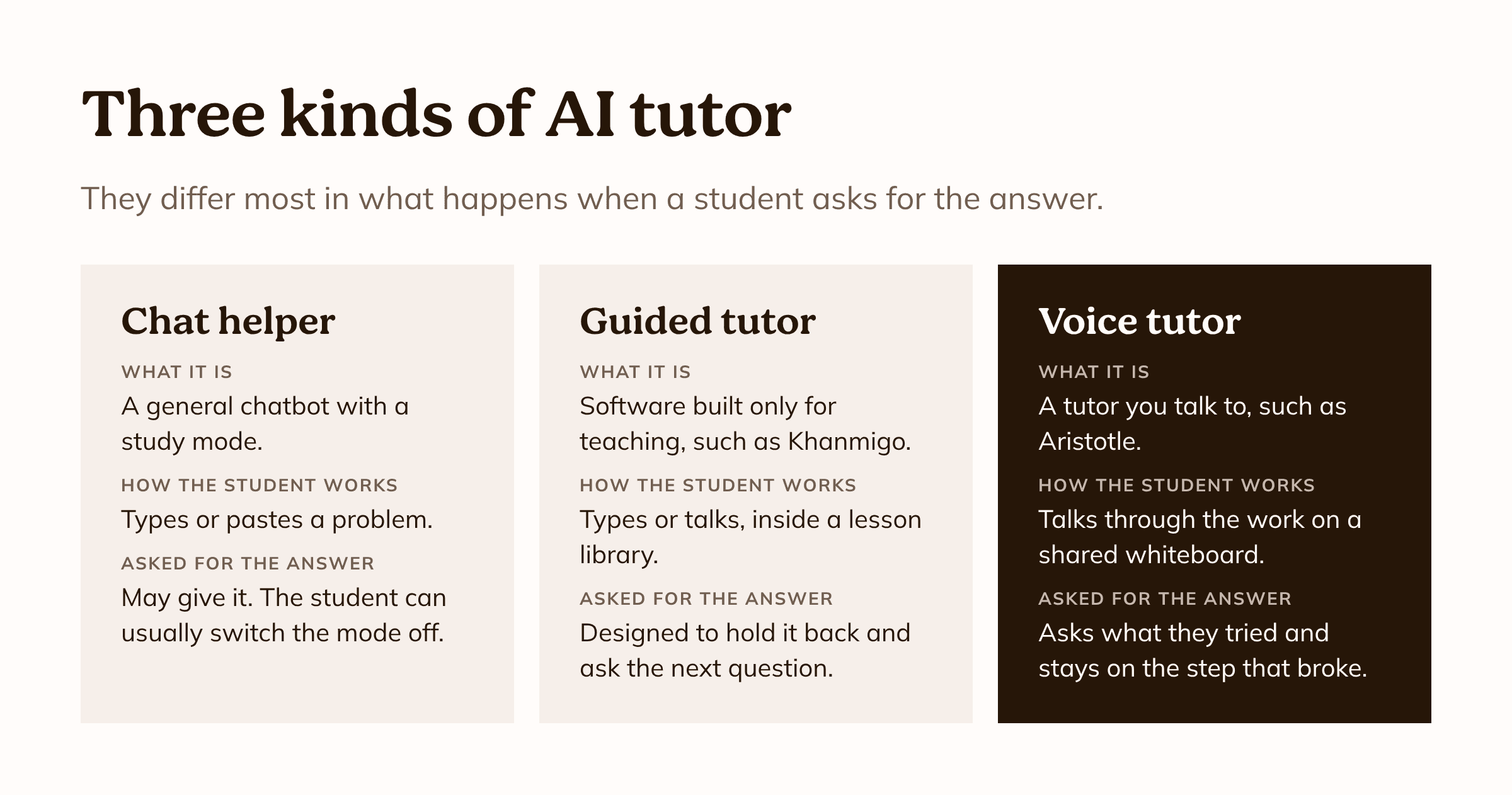
Most tools fall into three groups.
Chat helpers. A general chatbot with a study toggle. The student types. The tool may ask a question first, and it may still answer directly. The student can usually switch the mode off.
Guided tutors. Software built only for teaching. It is designed to withhold the final answer and walk the student through the next step. Khanmigo is one example on Khan Academy's library.
Voice tutors. The student talks through the work. The tutor listens and replies out loud, often on a shared whiteboard. Aristotle is in this group.
Does it guide or give answers?
Ask the tool for the answer to a problem your child already finished, and watch what it does. A guiding tutor asks what they have tried. An answer machine fills the screen.
Then stay quiet. If the tool keeps going until the solution is complete, it will do the same on tonight's homework.
What safety and privacy questions should parents ask?
Read the product's safety page and privacy policy before the first session. Look for whether raw audio is stored, whether transcripts are used only for the lesson, whether personal information is sold, and what happens when a conversation is flagged. Aristotle's answers are on the safety page: voice is processed live and raw audio is not stored, transcripts support the lesson and safety review, personal information is not sold, and flagged sessions go to a human on the safety team.
Which subjects and levels does it cover?
Match the tool to the classes your child is actually taking. A math-only app will not help with a history paper. Aristotle's subject list is on the subjects page, including math, science, and test prep. It is built for middle and high school students, and open to anyone who wants to learn.
Can parents see what happened in a session?
You should be able to review how a session went without sitting next to the student the whole time. Aristotle sends session summaries to parents. Paid plans also include a parent dashboard with progress insights. If a tool offers no history, you are trusting the student to tell you what it did.
How do you try one before committing?
Use the free plan or trial on a real assignment, not a demo problem. Bring work they are stuck on. After the session, ask them to explain the step without the tool. Aristotle's Intro plan is free with 3 one-hour sessions. The Infinite plan comes with a one-week free trial, and you can cancel from the dashboard at any time.
Before you start any trial, read whether it auto-renews and how you cancel. Do that on the vendor's own site, not a roundup.
| Question to ask | Why it matters | What to look for on the tool's site |
|---|---|---|
| Does it guide, or hand over the answer? | Why it mattersA finished solution finishes the worksheet without teaching the step. | What to look for on the tool's siteA statement that it withholds the final answer, plus a sample exchange. |
| Is guiding the default, or a mode the student can turn off? | Why it mattersA study toggle is easy to leave off when homework is due. | What to look for on the tool's siteWhether tutoring is the product, or a setting inside a general chat app. |
| Can the student talk, or only type? | Why it mattersExplaining a step out loud shows what they understand. | What to look for on the tool's siteVoice session, speech-to-text, or text only. |
| What does the safety and privacy page say? | Why it mattersYou need to know what is stored and who reviews flags. | What to look for on the tool's siteAudio retention, data sale, human review, and a contact for parents. |
| What can a parent see after a session? | Why it mattersWithout a summary, you cannot tell guiding from answer-giving. | What to look for on the tool's siteSession summaries, a dashboard, or no parent view. |
| Which subjects does it actually cover? | Why it mattersA math solver will not help with a lab write-up or an essay. | What to look for on the tool's siteA subject list that matches this year's classes. |
| Is there a free way to try it? | Why it mattersA real assignment is the only useful test. | What to look for on the tool's siteA free plan or trial, and whether a card is required. |
| How do you cancel? | Why it mattersTrials that need a card often convert unless you cancel. | What to look for on the tool's siteA cancel path you can find without calling sales. |
Get started today — we’d love for you to meet Aristotle yourself.
Questions parents ask
What is an AI tutor?
Software that works through school material with a student one-on-one, by text or voice, and adjusts to their answers.
Are AI tutors safe for kids?
It depends on the tool. Check its safety page, data policy, and parent controls.
How is an AI tutor different from ChatGPT?
Tutoring tools are built to teach step by step. General chatbots are built to answer.
How much has Aristotle been used?
Students have completed more than 5,000 sessions and 100,000 minutes of tutoring.