Blog
Voice vs. text AI tutoring
For parents of middle and high school students
Voice AI tutoring keeps the student talking through the work. Text AI tutoring waits for a typed prompt and often returns the solution. Those are different jobs. One produces an answer. The other produces an explanation the student had to say out loud.
Aristotle is a voice AI tutor for middle and high school students. Intro is free with three sessions. Infinite is $199 a month for unlimited sessions in every subject, with a one-week free trial. See how Aristotle's voice AI tutor works.
What does text AI tutoring do well?
Typing is quiet, precise, and easy to paste a problem into. If you want a definition, a recap, or a worked example to read, text is a good tool. Many chat tutors are built for that: prompt in, answer out.
The cost is that the student can skip the hard part. They never have to name the step they do not understand.
What does voice AI tutoring change?
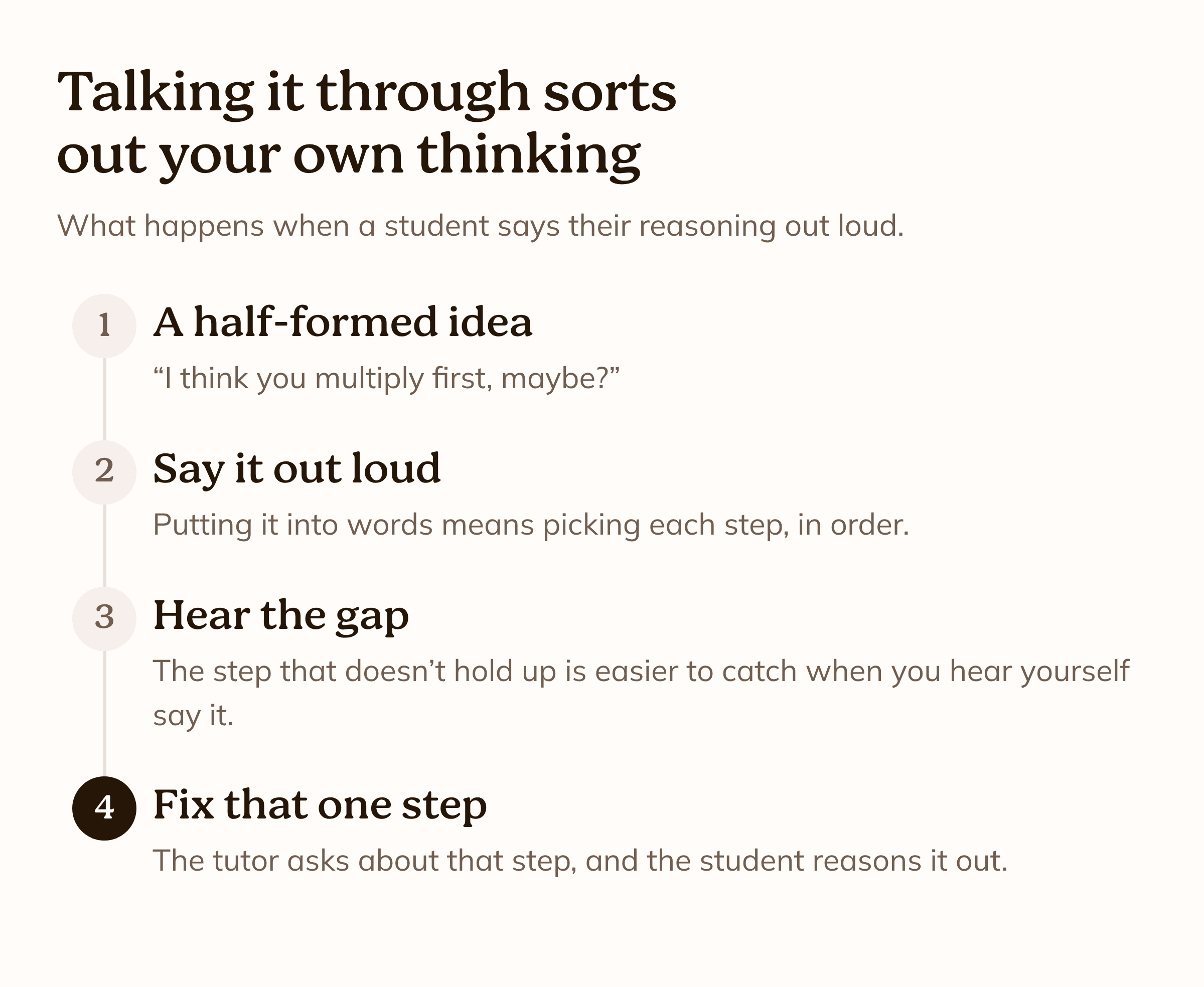
Talking helps a student get their own thoughts in order. A half-formed idea feels fine in your head. Saying it out loud forces you to pick each step, and the step that doesn't hold up is easier to hear. Aristotle can then ask about that step, and wait while they reason it out.
Researchers call this self-explanation. In a classic study, eighth graders who were prompted to explain each line of a science text to themselves understood it more deeply than students who read it twice (Chi et al., 1994).
The shared whiteboard holds the work they are talking over, so the conversation is not floating in audio alone.
They can interrupt. Next session it remembers where they stopped. Parents get a summary of what was said, not a chat log of pasted answers.
How do voice and text AI tutoring compare?
| Text AI tutoring | Voice AI tutoring | |
|---|---|---|
| Their own thinking | Can stay half-formed | Put into words, step by step |
| What the student does | Types or pastes a prompt | Says what they tried, out loud |
| What comes back | Often a worked solution | A question about the step that broke |
| Where the work lives | A chat log | A shared whiteboard |
| Interrupting | Wait for the reply to finish | Cut in mid-sentence |
| What parents see | Whatever is in the chat | A summary after every session |
Do you have to use voice?
No. Students who would rather not speak can still work on the whiteboard. Voice is how Aristotle is built to teach. It is not a requirement for opening a session.
Which one should a family start with?
Start with voice if the goal is that the student can explain the work, not collect a solution. Start free with three sessions and listen to one. If they only wanted a chatbot, cancel from the dashboard.
Get started today — we’d love for you to meet Aristotle yourself.
Questions parents ask
What is the difference between voice and text AI tutoring?
Text AI tutoring waits for a typed prompt and often returns the solution. Voice AI tutoring keeps the student talking through the work and asks the next question instead of handing over the answer.
Why does talking help my child think?
Saying a step out loud means putting it into words, so a gap in the reasoning is easier to notice. Aristotle asks about that step instead of reworking the whole problem.
Can my child switch between talking and the whiteboard?
Yes. They can talk, draw, or both in the same session.
When is typing better than talking?
When your child can’t talk out loud, like in a library. They can work on the whiteboard without speaking.