
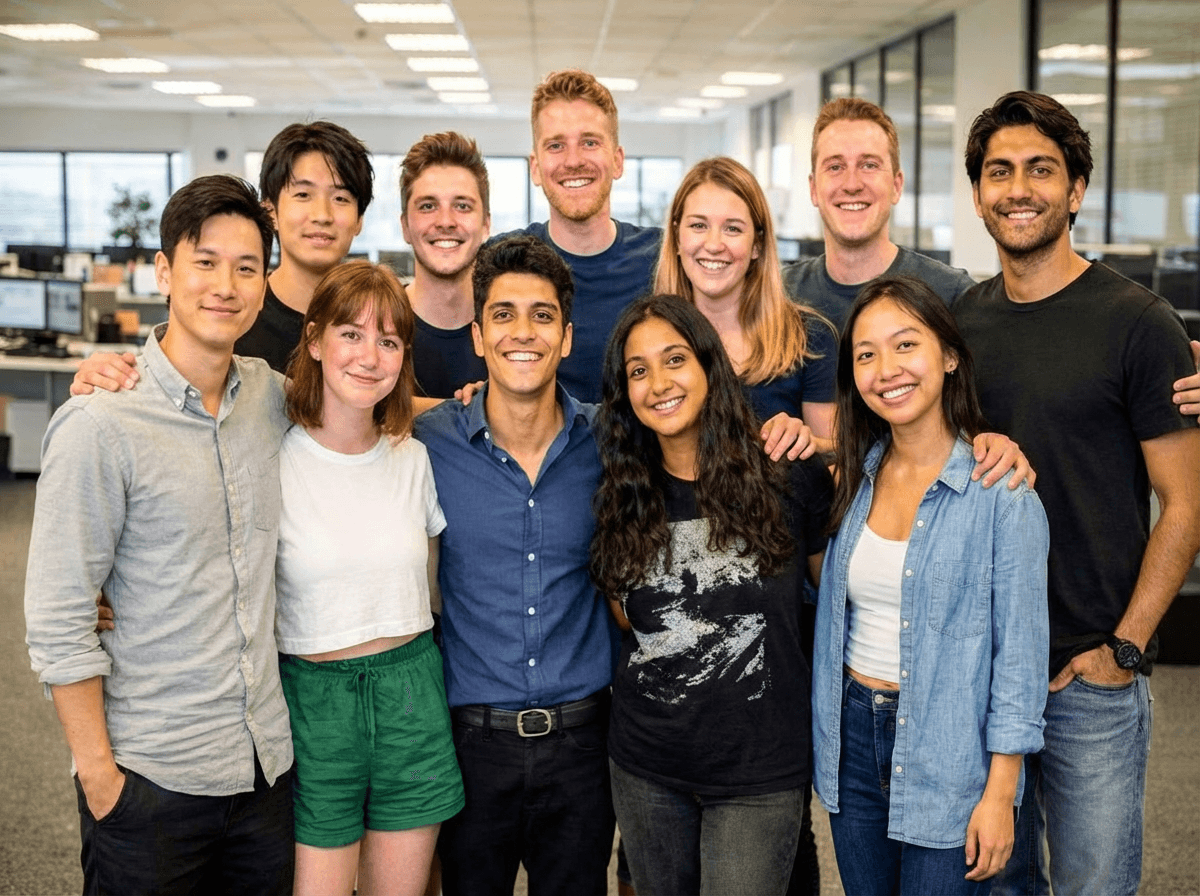
Today, we're announcing that Aristotle has raised $4.8M in seed funding. The round was led by True Ventures, with Wicklow Capital, and joined by an extraordinary group of angel investors and operators from OpenAI, Anthropic, Sierra, Ramp, Cognition, Mixpanel, and beyond.
This funding will allow us to build what we believe is long overdue: an AI tutor that actually teaches.
The problem
In 343 BCE, Philip II of Macedon made what may have been the most consequential hiring decision in recorded history: he engaged Aristotle to tutor his thirteen-year-old son, Alexander. The arrangement was straightforward. One exceptional teacher, fully devoted to one student, with the time and latitude to understand how that student thought. The results speak for themselves.
What Philip understood intuitively, modern research has since confirmed with remarkable precision. Benjamin Bloom's 1984 study demonstrated that students who received one-on-one tutoring performed two standard deviations above their peers in conventional classrooms, an effect so pronounced that it became known in education research as “the 2 sigma problem” (Bloom, 1984). The finding was not controversial; it was simply impractical. The economics of dedicating one qualified teacher to one student have never scaled, and likely never will through traditional means.
The numbers today are sobering. Parents in the United States spend over $14 billion annually on tutoring, yet the vast majority of students still never receive meaningful individual attention. Reading comprehension scores have fallen to 1992 levels; math proficiency sits at its lowest point in two decades; only one in four students can write coherently (NAEP, 2023). These are not marginal declines. They represent a systemic failure in how we deliver education at scale.
It is worth noting that the problem is not one of content. Textbooks, instructional videos, Khan Academy lessons: the raw material of learning has never been more abundant or more accessible. But teaching is not content delivery. The difference between a student who understands a concept and one who memorizes a procedure often comes down to a single moment: the instant when confusion begins to form, when a skilled tutor intervenes with the right question or reframing before frustration hardens into disengagement.
What we're building
Aristotle is an AI tutor designed to do what great human tutors have always done: teach. Not by providing answers, but by guiding students through the process of arriving at understanding on their own.
Most existing AI tools function as sophisticated reference engines; they are responsive to queries but fundamentally passive. Aristotle is different. It maintains a persistent model of each student that deepens over months of interaction. Three capabilities are central to this approach.
The first is longitudinal memory. Aristotle tracks what each student has mastered, where they consistently struggle, and what motivates them. This is not a session transcript; it is a growing pedagogical profile that informs every subsequent interaction, much as a skilled human tutor builds an evolving mental model of their student over time.
The second is real-time adaptation. When a student's confusion begins to surface, through hesitation, incorrect responses, or subtle shifts in engagement, the system adjusts its explanations before the student disengages entirely. This requires a fundamentally different architecture than conventional chatbot-style question-and-answer systems, one built specifically around the dynamics of teaching and learning.
The third is resistance to gaming. Students, particularly adolescents, are remarkably creative at finding shortcuts. When a student attempts to extract answers rather than engage with the material, Aristotle redirects them, patiently and persistently, toward genuine understanding. The system is designed to teach, not to comply.
Why now
For decades, the 2 sigma problem remained exactly that: a problem with no viable solution at scale. The technology simply was not there. Large language models have changed this calculus. For the first time, it is technically feasible to build systems that can maintain pedagogical state across extended interactions, adapt explanations in real time based on student comprehension, and engage with the kind of nuance and patience that effective teaching demands. The qualities that distinguished history's finest tutors, personality, memory, proactive intervention, and genuine patience, are no longer exclusively human capacities; they can now be engineered into software.
But technical capability, on its own, is insufficient. What matters equally is alignment: whose interests does the system serve? We have built Aristotle for parents. Every guardrail, every incentive structure, every design decision is oriented around a parent's interest in their child's genuine intellectual growth. This is not a feature we added after the fact; it is the foundational principle of the architecture.
